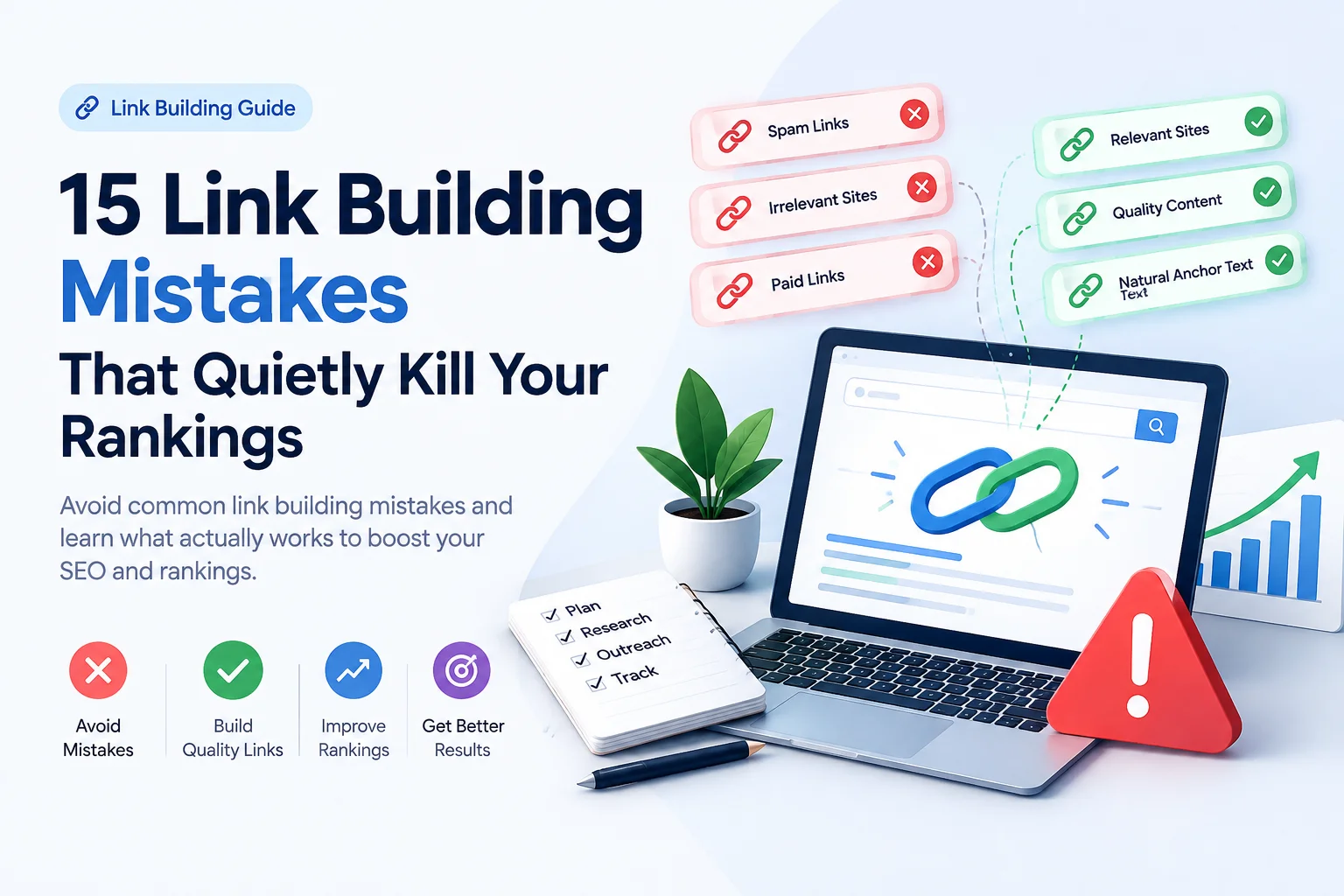
15 Link Building Mistakes That Quietly Kill Your Rankings (And What Actually Works)
A few months ago, a client proudly showed me his report.
“400 backlinks in three months,” he said.
I opened his analytics. Traffic was flat. Rankings barely moved.
Most of those links came from random directories and comment spam that nobody ever clicks.
This is the exact problem I see almost every week.
People chase numbers instead of value.
A handful of relevant, trusted backlinks almost always beat hundreds of weak ones. In this guide, I’ll walk you through the 15 most common link-building mistakes and what to do instead—so your effort actually moves the needle.
What Is Link Building (In Simple Words)
Link building means getting other websites to link to yours.
Those links are called backlinks.
Search engines treat a good backlink like a recommendation. When a respected site in your niche points to your page, it tells Google (and real people) that your content is worth looking at.
Quality beats quantity—every single time.
Why These Mistakes Matter
Not every backlink helps.
Some add almost nothing. Others slowly damage how natural your profile looks.
One weak link rarely tanks a site overnight. But a pattern of bad decisions wastes money and can hold your rankings back for months.
Here are the mistakes I see most often — and the better way forward.
15 Link Building Mistakes to Avoid
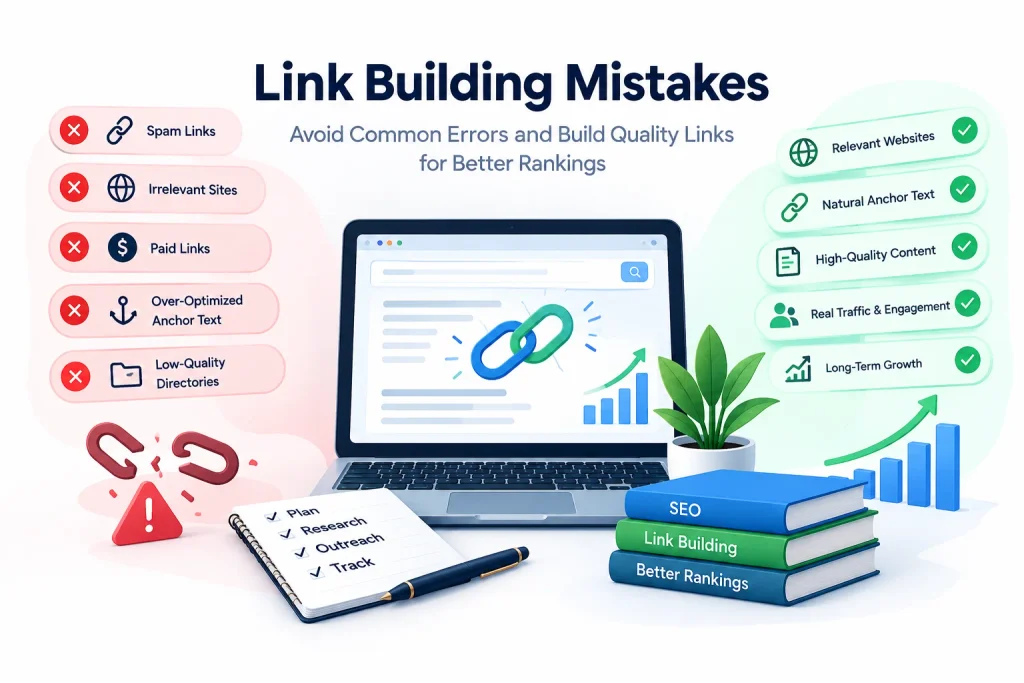
1. Chasing Quantity Over Quality
More links do not automatically mean more authority.
One strong, relevant backlink is usually worth more than fifty weak ones.
Ask yourself: Does this link make sense for my audience and niche?
2. Getting Links From Completely Irrelevant Sites
A pet blog linking to your SaaS tool does little.
Search engines notice relevance. So do real readers.
Prioritise sites that cover topics close to yours—even if they are smaller.
3. Buying Links Without Understanding the Risk
There is a big difference between properly disclosed sponsored content and buying links just to manipulate rankings.
The second one goes against Google’s guidelines and can create long-term problems.
If you’re unsure, check Google’s current advice on link schemes before you spend money.
4. Using the Exact Same Anchor Text Over and Over
If every link to your site says “best accounting software,” it starts looking unnatural.
Real websites use a mix of brand names, plain URLs, and natural phrases.
Aim for the same variety.
5. Stuffing Exact-Match Keywords Everywhere
Exact-match anchors are fine in moderation.
Using them in almost every link quickly becomes over-optimisation.
Let the anchor text fit the sentence naturally — even if it’s not a perfect keyword match.
6. Guest Posting on Low-Quality Sites
Guest posting still works, but only on sites with real readers and real editorial standards.
Sites that accept anything for a fee rarely help.
Before you pitch, check if the site publishes useful content and if people actually engage with it.
If you’re looking for suitable publications, you can also learn how to find guest post opportunities before starting your outreach.
7. Ignoring Relevance Completely
It’s tempting to take any link that comes your way.
But a link from a totally unrelated site does little for rankings or reputation.
A smaller relevant site is almost always better than a big unrelated one.
8. Obsessing Over Domain Authority Scores Alone
Domain Authority and similar metrics are useful rough guides.
Google doesn’t use them directly.
Look at the full picture: real traffic, content quality, reputation, and topical fit.
You can also compare potential placements against a list of premium guest post sites rather than judging a website by its authority metric alone.
9. Building Links Too Fast and Aggressively
There is no magic number of links per month.
What matters is whether the growth looks natural for a site of your age and size.
A brand-new site suddenly getting thousands of links in a week raises red flags. Slow and steady usually wins.
10. Ignoring the Context Around the Anchor Text
The words around the link matter as much as the anchor itself.
A link that sits naturally inside a helpful sentence carries more weight than one dropped awkwardly at the end.
When you can influence placement, ask for it to feel natural.
11. Relying on Automated or Spammy Methods
Blog comment spam, mass directory submissions, and link farms produce lots of low-quality links.
Search engines are good at spotting them.
Manual, thoughtful outreach takes longer — but the results last.
A white-hat link building approach focuses on relevant placements rather than automated or manipulative methods.
12. Ignoring Lost or Broken Backlinks
Link building is not only about getting new links.
Pages get deleted. Sites redesign. Old links disappear or point to 404s.
If you want to understand the process in more detail, learn how to check backlinks of a website and review your backlink profile regularly.
Check your profile every few months and reclaim the good ones when it makes sense.
13. Forgetting About Internal Links
Most people focus only on external links.
Internal links (links between your own pages) also matter a lot.
They help visitors find related content and help search engines understand your site structure.
14. Trying to Build Links to Weak Content
It’s hard to earn good links to a page that offers nothing new.
Original research, detailed guides, free tools, and useful templates give other sites a real reason to link.
Make the page worth linking to first.
15. Never Review Your Backlink Profile
Many people build links for a while and then forget about them.
Looking at your profile every few months helps you spot spam, lost links, and patterns that need fixing.
Disavowing is for serious cases — not a monthly cleanup routine.
How to Avoid These Mistakes (Simple Process)
Here’s a practical checklist I use with clients:
- Decide the link’s purpose before you chase it.
- Check if the site is relevant to your industry.
- Look at the specific page where the link will sit.
- Judge the site’s overall content quality.
- See how naturally the link fits the surrounding text.
- Use anchor text that reads like a real sentence.
- Focus on content that is actually useful.
- Keep a simple record of the links you get.
- Review the full profile every few months.
Quick Way to Evaluate Any Backlink Opportunity
Ask yourself these questions:
- Is this site relevant to my topic?
- Does it have real, useful content?
- Would a real reader find this link helpful?
- Does the site seem to exist mainly to sell links?
- Is the anchor text natural?
If most answers are yes, the link is probably worth pursuing.
What a Good Backlink Actually Looks Like
A strong backlink usually comes from a relevant site with real readers.
It sits inside content that makes sense. The anchor text fits the sentence.
It does not have to be dofollow to be valuable. Nofollow links still send traffic and help create a natural-looking profile.
For a deeper explanation of link attributes, see dofollow vs nofollow links.
Better Alternatives to Bad Link Building
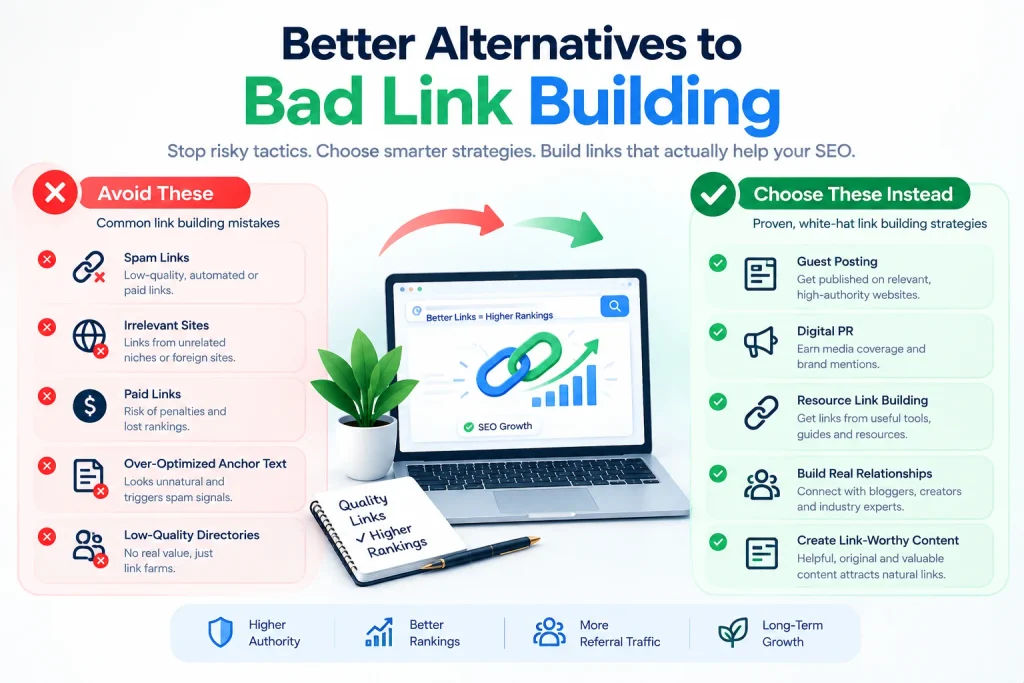
Focus on methods that hold up long-term:
- High-quality guest posts on relevant sites
- Digital PR around real news or data
- Original research other sites want to cite
- Free tools, templates, or calculators
- Resource page placements
- Partnerships in your industry
- Expert contributions to publications
- Reclaiming unlinked brand mentions
- Fixing broken link opportunities
These approaches take more effort — but the links they produce are safer and more useful.
If you’re deciding between different approaches, you can also read this comparison of guest posting vs press releases to understand how the two strategies differ.
Frequently Asked Questions
What is the biggest link building mistake?
Focusing on quantity instead of relevance and quality.
Can bad backlinks hurt SEO?
A pattern of low-quality or manipulative links can weaken your profile over time. One weak link rarely causes serious damage on its own.
Is buying backlinks bad?
Buying links purely to manipulate rankings goes against Google’s guidelines. Properly disclosed paid promotion is different.
How many backlinks should I build?
There is no magic number. Natural growth for your site’s age and industry matters more.
Is guest posting still useful?
Yes — when done on relevant, high-quality sites with real audiences.
Should I remove every low-quality backlink?
No. Disavowing is for serious cases, not routine cleanup.
Is exact-match anchor text dangerous?
Occasional use is normal. Overusing it looks unnatural.
How can I check my backlinks?
Use tools like Google Search Console, Ahrefs, Semrush, or Moz. You can also follow this practical guide on how to check a website’s backlinks.
Final Thoughts
Good link building is not about collecting the highest number of backlinks.
It’s about earning relevant, useful, natural links that make sense for real readers and for your site.
Avoid the mistakes in this guide, and your link-building work will support your SEO instead of working against it.
Evaluate each opportunity carefully — and the results tend to hold up much better over time.
About the Author
Shahzad Khan — SEO & Digital PR Expert, Founder of shahzadmarketer.com. Helps agencies and businesses get published on top-tier publications and build authority through white-hat link building.
Featured Work
Published with the assistance of Shahzad Marketer on Indie Hackers, covering practical insights about browser-based ZIP tools and online file handling.
Get in Touch
Questions about guest posting, press releases, or getting your brand featured on premium publications? Shahzad is available directly through the channels below:
Email: shahzad@shahzadmarketer.com
LinkedIn: https://www.linkedin.com/in/shahzadmarketer/
WhatsApp: +44 7848 475000
Website: https://shahzadmarketer.com