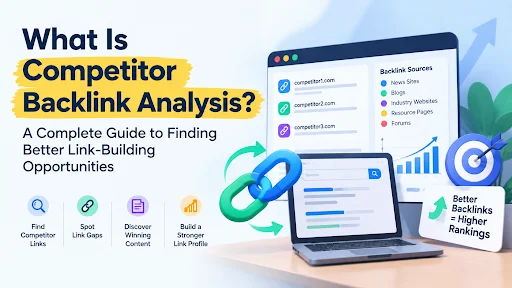
What Is Competitor Backlink Analysis? A Complete Guide to Finding Better Link-Building Opportunities
If your competitors are consistently ranking above you in Google, one of the first questions worth asking is not simply, “How many backlinks do they have?”
A better question is:
Where are their backlinks coming from, which pages are attracting those links, and which of those opportunities could realistically be earned by your website?
That is the idea behind competitor backlink analysis.
In this guide, we explain what competitor backlink analysis is and why it matters. You will learn how to perform it step by step and check key metrics. Then, you can turn this data into a successful link-building campaign.
What Exactly Is Competitor Backlink Analysis?
Competitor backlink analysis is the systematic study of the websites and pages linking to your competitors.
A backlink is a hyperlink from one website to another. When a website links to a page on your competitor’s domain, that link becomes part of the competitor’s backlink profile.
For example, imagine you run a SaaS company and one of your competitors consistently ranks above you for important commercial keywords.
A backlink analysis might reveal that the competitor has earned links from:
- Industry publications
- SaaS blogs
- Technology websites
- Business publications
- Resource pages
- Expert roundups
- Product comparison articles
- Interviews
- Digital PR campaigns
- Partner websites
You can then investigate these referring domains and determine whether similar opportunities exist for your own website.
This does not mean copying every backlink your competitor has.
Instead, the objective is to understand how competitors have built authority and where legitimate, relevant opportunities exist for your site.
Competitor backlink analysis helps you uncover a competitor’s links, referring domains, and top-linked pages. Semrush shows how you can turn this data into new link-building opportunities.
Why Does Competitor Backlink Analysis Matter?
Backlink analysis gives you something that ordinary keyword research cannot:
It shows you the websites that are already willing to reference businesses or content within your market.
That can make prospecting much more focused.
Google states that its ranking systems use link analysis, such as PageRank, to understand how pages connect and assess content. Google also warns that links made mainly to game rankings can break its spam rules.
Therefore, the goal should not be to acquire the largest possible number of backlinks. The aim is to find relevant, justified, and truly useful link opportunities.
A competitor backlink analysis can help you:
1. Discover New Link Opportunities
Your competitors might connect with publications, bloggers, and associations. They may also link to resource pages and industry websites you haven’t found yet.
Competitor research helps you start your prospecting with a list of potential sources.
2. Identify Link Gaps
A backlink gap exists when a website links to one or more competitors but does not link to your website.
For example:
| Website | Competitor A | Competitor B | Your Site |
| IndustryBlog.com | Have | Have | Don’t have |
| BusinessNews.com | Have | Doesn’t have | Don’t have |
| SaaSGuide.com | Doesn’t have | Have | Have |
The first domain may deserve investigation because it already links to multiple businesses in your competitive space.
Semrush’s Backlink Gap tool is specifically designed to identify domains linking to competitors but not to your site.
3. Understand What Content Attracts Links
Backlink analysis is not only about domains.
Look at the pages receiving the links.
You may discover that your competitor’s strongest link acquisition comes from:
- Original research
- Statistics pages
- Detailed guides
- Free tools
- Templates
- Industry reports
- Case studies
- Data studies
- Opinion pieces
- Digital PR campaigns
That information can influence your own content strategy.
4. Understand Competitor Link-Building Patterns
A competitor who gets links from relevant publications each month may invest in digital PR. They might also use guest posting, partnerships, or content promotion.
Another competitor may have relatively few referring domains but several strong editorial mentions.
These are very different link-building profiles.
The purpose of analysis is to understand the pattern, not simply count links.
Competitor Backlink Analysis vs. Competitor SEO Analysis
These terms are related but not identical.
A complete competitor SEO analysis can include:
- Organic keywords
- Search visibility
- Top-ranking pages
- Content strategy
- Technical SEO
- Internal linking
- Backlinks
- Referring domains
- Digital PR
- SERP features
- AI search visibility
Competitor backlink analysis focuses specifically on the link side of that picture.
Think of it this way:
Competitor SEO analysis = the whole competitive picture
Competitor backlink analysis = the competitor’s link profile and link acquisition opportunities
This narrower focus makes backlink analysis particularly useful when your website has good content but lacks the authority or external references needed to compete for difficult search results.
How to Perform a Competitor Backlink Analysis Step by Step
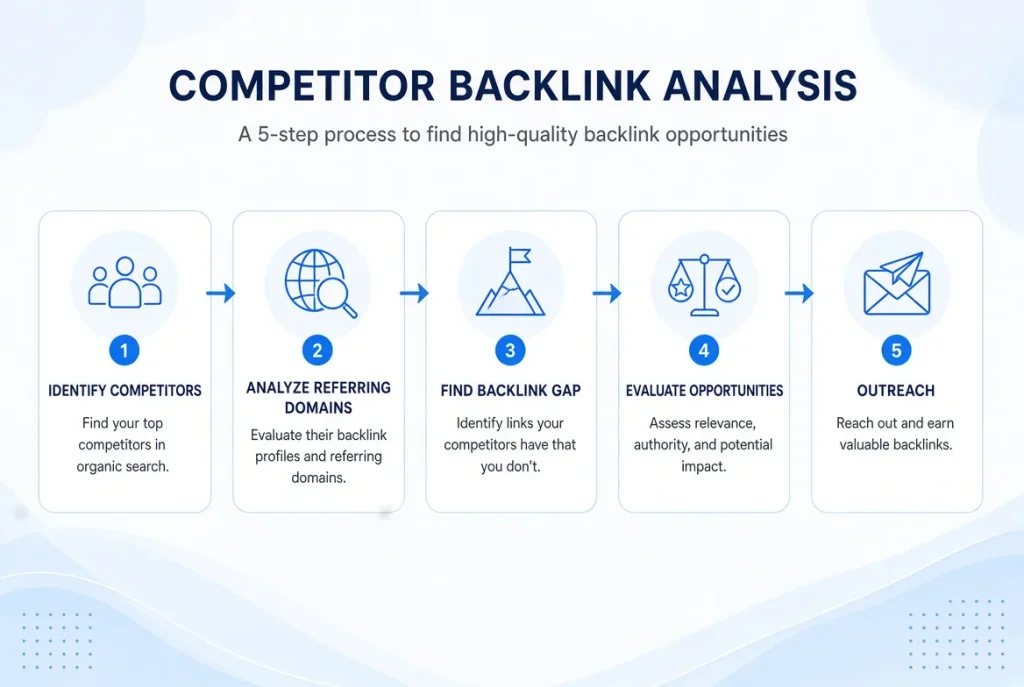
Step 1: Identify Your Real SEO Competitors
Don’t automatically choose the biggest companies in your industry.
Your SEO competitors are websites competing for the same search queries and audiences.
For example, if you sell SEO services, your competitors may include:
- SEO agencies
- Link-building agencies
- Digital PR companies
- Specialized SEO consultants
- Content marketing agencies
A company can be your business competitor without being your direct SEO competitor.
Start by identifying websites ranking for the keywords you actually want to target.
Step 2: Choose 3–5 Competitors
You don’t need to analyze dozens of domains initially.
A practical starting point is to select several competitors that:
- Rank for your target keywords
- Have relevant content
- Have established backlink profiles
- Operate in the same geographic or commercial market
- Have pages similar to the pages you want to rank
Using several competitors is important because one competitor’s backlink profile can be unusual.
If the same type of website links to multiple competitors, however, the opportunity becomes more interesting.
Step 3: Analyze Referring Domains
A referring domain is a unique website that links to another website.
This is different from total backlinks.
For example:
1 referring domain → 50 backlinks
means one website may have created 50 links to your competitor.
Meanwhile:
50 referring domains → 50 backlinks
means 50 different websites are linking to the competitor.
For competitive research, referring domains can provide useful context because they show how broad the competitor’s external link network is.
Semrush’s backlink research tools, for example, provide information about referring domains, backlinks, linked pages, and other backlink attributes.
Step 4: Look Beyond Domain Authority
One of the most common mistakes in backlink analysis is judging every opportunity using a single metric.
Metrics such as Domain Rating, Domain Authority, or Authority Score can be useful for filtering prospects, but they should not be treated as Google’s official ranking scores.
A website with a high third-party authority metric is not automatically a valuable link.
Evaluate the website using multiple factors:
Relevance
Does the website actually cover your industry or audience?
Editorial Quality
Does it publish useful original content or thousands of thin articles?
Organic Visibility
Does the website appear to receive genuine search traffic?
Content Quality
Would a real reader find the publication useful?
Link Placement
Is the link naturally included within relevant editorial content?
Traffic Potential
Could the publication send actual referral visitors?
Reputation
Does the website have a credible presence in its industry?
A relevant publication with genuine readers may be more strategically useful than a random website with an impressive-looking SEO metric.
Step 5: Analyze the Competitor’s Top-Linked Pages
This is one of the most valuable parts of competitor backlink analysis.
Find the pages on your competitor’s website that attract the most referring domains.
Then ask:
Why are people linking to this page?
Suppose a competitor has a page called:
“50 SEO Statistics You Need to Know”
and that page has attracted dozens of referring domains.
The lesson isn’t necessarily:
“I need the same article.”
The deeper lesson could be:
“Publishers and bloggers in this industry need reliable statistics they can cite.”
You could therefore create a more useful research-based resource containing:
- Updated statistics
- Original analysis
- Expert commentary
- Sources
- Charts
- Industry-specific data
That gives you something genuinely link-worthy rather than simply copying the competitor’s page.
Step 6: Examine Anchor Text
Anchor text is the clickable text used for a hyperlink.
For example:
SEO link building guide
could link to a page about link-building strategies.
Anchor text analysis helps you understand how competitors are being referenced across the web.
However, this is an area where SEO professionals need to be careful.
Google’s spam policies specifically identify manipulative link practices, including optimized anchor text in certain paid or sponsored placements and other link schemes.
A healthy backlink strategy should therefore prioritize natural editorial context instead of trying to force exact-match keywords into every link.
Step 7: Find the Backlink Gap
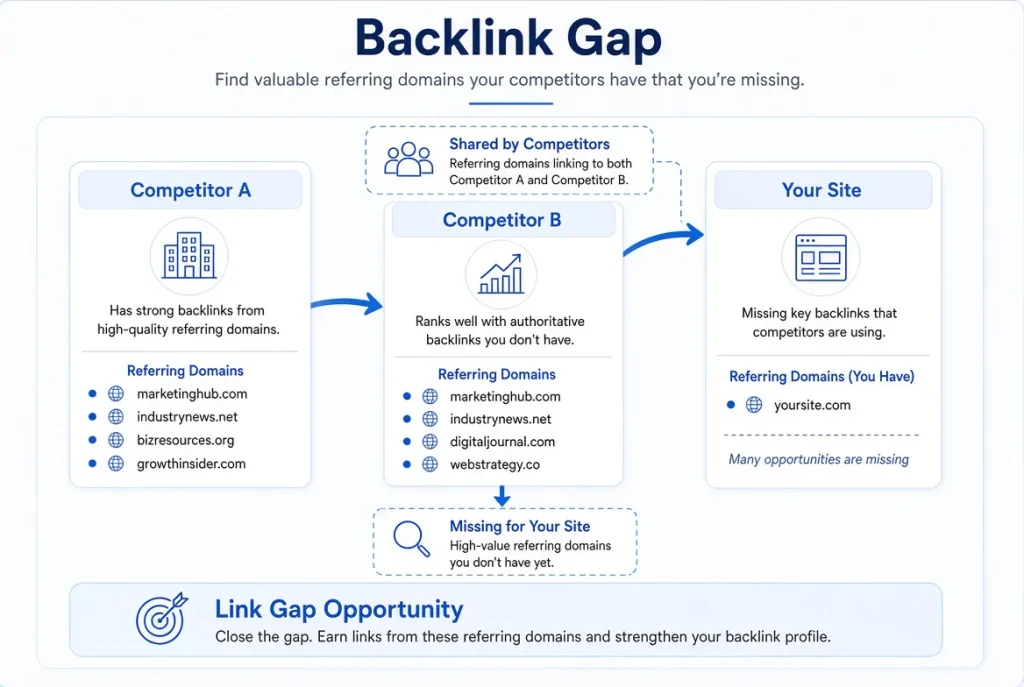
Now compare your backlink profile with those of your competitors.
If three of your five competitors have backlinks from the same referring domain, investigate that domain first. Open the actual linking pages, check why each competitor was mentioned, and determine whether you have a relevant page, resource, product, or data point that genuinely deserves inclusion.
This is where competitor research becomes an actual prospecting list.
Semrush’s Backlink Gap workflow allows marketers to compare domains and identify referring websites that link to competitors but not to their own domain.
Step 8: Categorize Your Link Opportunities
Don’t put every backlink into one spreadsheet column.
Create categories such as:
| Opportunity Type | Example |
| Guest Post | Relevant industry publication |
| Digital PR | News or business publication |
| Resource Link | Industry resource page |
| Expert Quote | Journalist or publisher request |
| Broken Link | Relevant dead resource |
| Unlinked Mention | Brand mentioned without a link |
| Partnership | Vendor, association, or partner |
| Original Research | Data that publishers can cite |
This makes your outreach strategy much more organized.
Step 9: Evaluate Whether the Link Is Actually Replicable
This is where experience matters.
Not every competitor backlink is an opportunity.
A competitor may have a link because:
- Its founder was interviewed
- It sponsored an event
- It was mentioned in an old news story
- It has a unique product
- It conducted original research
- It has an existing partnership
- It owns another company
- It received a natural editorial citation
You cannot simply assume that because your competitor received the link, you can obtain the same link.
Instead ask:
Why did the publisher link to them?
Then determine whether you can create a legitimate reason for that publisher to reference your website.
What Tools Can You Use for Competitor Backlink Analysis?
Several established SEO tools can help with backlink research.
Semrush
Semrush provides competitor backlink research, referring-domain information, linked-page data and its Backlink Gap workflow.
Its Backlink Gap tool is specifically designed to identify domains linking to competitors but not to your website.
Ahrefs
Ahrefs is another widely used SEO platform with backlink analysis capabilities, including referring domains, backlinks, anchor text and linked pages.
It can be particularly useful when you want to examine a competitor’s link profile at both domain and page level.
Google Search Console
Google Search Console is useful for analyzing your own site’s link data and understanding how Google reports links associated with your website.
It is not a replacement for a complete competitor backlink database because you do not get the same competitor-level backlink intelligence.
Majestic
Majestic is another specialist backlink analysis platform that provides its own link indexes and proprietary metrics for evaluating backlink profiles.
What Makes a Good Competitor Backlink?
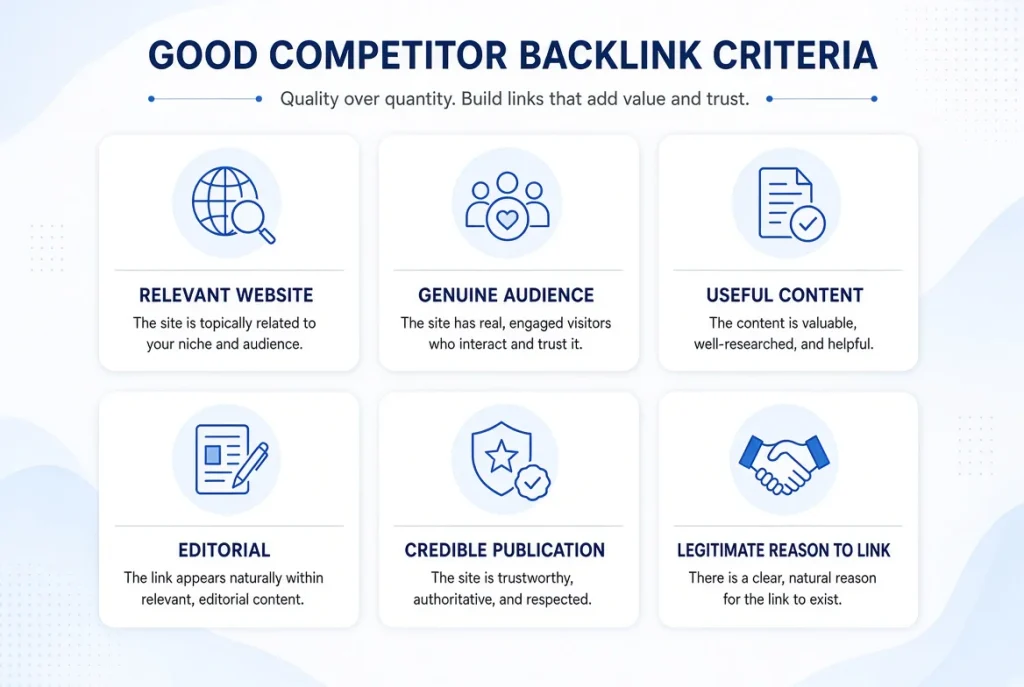
There is no universal number that makes a backlink “good.”
Instead, evaluate the context.
A strong prospect generally has several of these characteristics:
Relevant website + genuine audience + useful content + editorial context + credible publication + legitimate reason for linking
For example, imagine you operate an accounting software company.
A link from a respected accounting publication discussing:
“Best Accounting Software for Small Businesses”
could be highly relevant.
A random website about an unrelated topic publishing hundreds of generic articles may have a high SEO metric but provide little strategic value.
Relevance should never be ignored simply because a metric looks impressive.
Competitor Backlinks Should Not Be Copied Blindly
This is perhaps the most important lesson.
Competitor backlink analysis is a research technique, not a shortcut around quality.
Google explicitly warns against link spam, including buying or selling links for ranking purposes, excessive link exchanges, automated link creation, low-quality directories, and other manipulative practices.
Google also recommends creating unique, compelling content that people naturally want to reference rather than relying on unnatural link schemes.
Therefore, the correct workflow is:
Analyze → Understand → Qualify → Create Value → Outreach → Earn
Not:
Analyze → Copy → Buy 100 Links
The second approach can create a backlink profile that looks impressive in a spreadsheet but provides little sustainable SEO value.
How Shahzad Marketer Approaches Link Building
My name is Shahzad, and I am an SEO marketer. I do not focus on getting hundreds of low-quality links just to increase numbers. Instead, I focus on getting good, trustworthy links that actually help your website rank better for a long time.
Before I start any work, I look closely at your business. I check who your competitors are, who your main audience is, and what links you already have. This shows me where the best opportunities are.
After that, I start contacting real site owners in your specific industry. I talk to them directly so we can get natural links on relevant websites.
Over the years, I’ve worked with 500+ clients, published 10,000+ guest posts, and built 25K+ backlinks, according to the results reported on my website. I’ve also maintained a 98% client satisfaction rate based on reported client feedback.
My clients have also shared results from their campaigns. For example, one Finnish technology startup reported an increase in Domain Authority from 28 to 45 in four months, while another client reported a 30% increase in sales inquiries after a backlink campaign.
These results come directly from client feedback and campaign reports. I prefer to be honest and realistic rather than make fake guarantees. For me, good link building isn’t about chasing huge numbers. It’s about earning relevant links that build authority, boost visibility, and drive long-term growth.
A Practical Competitor Backlink Analysis Framework
If you are doing this for a real SEO campaign, create a spreadsheet with columns like these:
| Metric | What to Record |
| Competitor | Competitor domain |
| Referring Domain | Website linking to competitor |
| Linking URL | Exact page containing the link |
| Target URL | Competitor page receiving the link |
| Anchor Text | Text used for the link |
| Link Type | Editorial, resource, guest post, PR, etc. |
| Relevance | High / Medium / Low |
| Traffic Potential | Low / Medium / High |
| Editorial Quality | Low / Medium / High |
| Replicability | Easy / Moderate / Difficult |
| Outreach Method | Email, PR, guest contribution, relationship, etc. |
| Priority | High / Medium / Low |
| Notes | Why the opportunity matters |
This turns a backlink report into an actual link-building roadmap.
Common Competitor Backlink Analysis Mistakes
Mistake 1: Looking Only at Total Backlinks
Just because a competitor has 100,000 backlinks doesn’t mean you need that many. Investigate referring domains, relevance, linked pages and quality.
Mistake 2: Chasing High Authority Metrics
Don’t build a campaign around a single third-party metric.
Look at the whole website.
Mistake 3: Ignoring Relevance
A backlink from an unrelated website may not make sense for your audience or content.
Mistake 4: Copying Competitors
Competitor research should generate ideas, not duplicate content or manipulative link schemes.
Mistake 5: Ignoring the Linked Page
Always investigate which page received the backlink and why.
That often reveals the real content strategy behind the link.
Mistake 6: Treating Every Link as Replicable
Some links exist because of relationships, news events, products, partnerships or unique research.
They may not be realistically reproducible.
Mistake 7: Focusing on Quantity Instead of Opportunity
A smaller number of highly relevant prospects can be more useful than a giant list of random domains.
How Often Should You Perform Competitor Backlink Analysis?
There is no universal schedule.
For an active SEO campaign, start with a detailed analysis in the strategy phase. Then, monitor significant changes regularly.
You may want to review competitors when:
- A major competitor suddenly gains visibility
- A competitor launches a major content campaign
- Your rankings stop improving
- A competitor enters your market
- You launch a new product or category
- You begin a new link-building campaign
The objective is not to obsess over every new backlink.
Instead, look for patterns that can influence your strategy.
Final Thoughts
In my SEO experience, analysing competitor backlinks works best. You should focus on why they get links. It’s not just about copying them. I look at their referring sites, top pages, content quality, and how they get links. This helps me find the right opportunities for my own website.
My goal isn’t to get the most backlinks. Instead, I focus on quality links with great content and real outreach. Combine backlink data with a smart strategy. This helps you find new opportunities and boost your search rankings.
Get in Touch
Questions about guest posting, press releases, or getting your brand featured on premium publications? Shahzad is available directly through the channels below:
Email: shahzad@shahzadmarketer.com
LinkedIn: https://www.linkedin.com/in/shahzadmarketer/
WhatsApp: +44 7848 475000
Website: https://shahzadmarketer.com