Anchor Text Diversity Strategy: How to Build a Natural Backlink Profile
Quick question.
If someone read your backlink profile out loud, would it sound like real people talk about your site? Or would it sound like one keyword copied and pasted fifty times?
Be honest. For most websites, it’s the second one.
And here’s the thing — nobody plans it that way. You order a few guest posts. You tell the writer, “use my main keyword.” Repeat that a few times, and suddenly half your links say the exact same commercial phrase.
Google sees that pattern. It’s been seeing it for years.
That’s exactly why you need an anchor text diversity strategy. Not because some guru invented a magic ratio. But because real websites link naturally, and yours should too.
In this guide, I’ll walk you through what anchor text diversity actually means, which anchor types matter, how to build a healthy mix, and how to check your own profile step by step.
Let’s get into it.
What Is Anchor Text Diversity?
Anchor text is the clickable part of a link.
Simple example. If a blog writes “check out this anchor text diversity strategy guide” and links to your page — that whole phrase is the anchor. Google reads it as a hint about what’s on the other side of that link.
Now, diversity just means you don’t use the same phrase every time.
Think about real life for a second. When your friend recommends a tool, he doesn’t call it “the best project management software” every single time. Sometimes he says the brand name. Sometimes he drops the link. Sometimes it’s just “this app I’ve been using.”
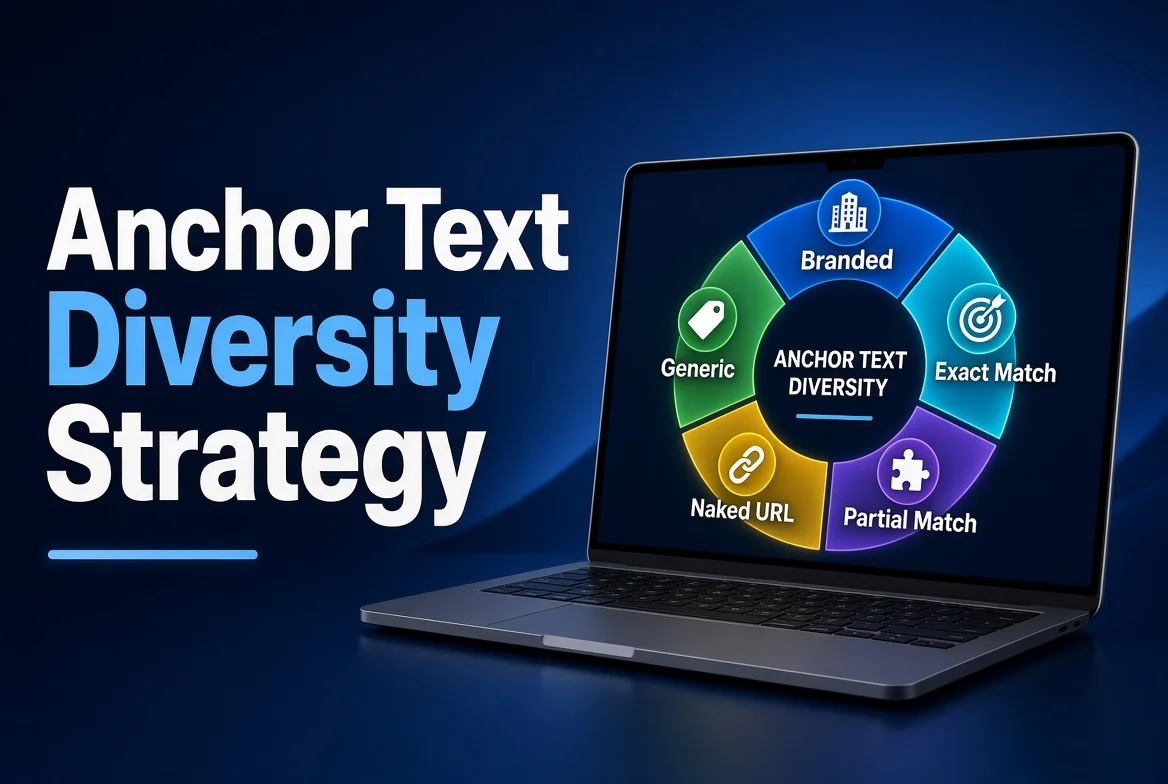
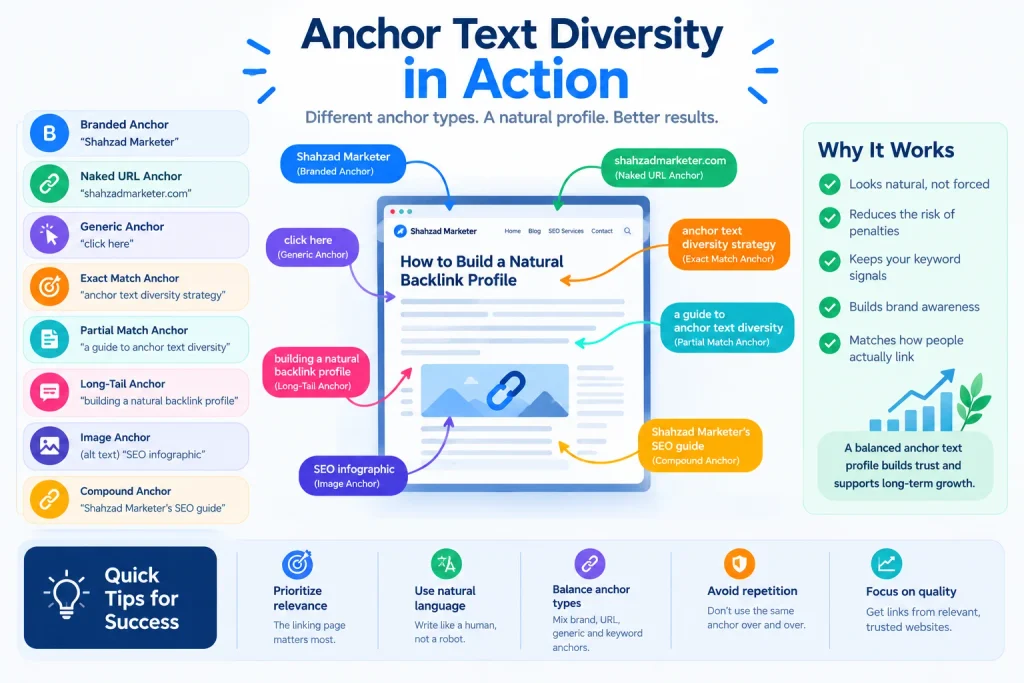
Your backlinks should sound the same way. A natural mix includes:
- Branded anchors — your brand name
- Naked URLs — the plain web address
- Generic anchors — “click here,” “this article,” “read more”
- Partial match — your keyword plus extra words
- Exact match — the precise keyword, used rarely
- Long natural phrases — the kind that fit a sentence
- Image anchors — where the alt text acts as the anchor
That’s the whole idea. Variety instead of repetition.
Why Anchor Text Diversity Matters for SEO
Search engines are built to spot patterns. That’s literally their job.
So when Google crawls your links and finds the same money keyword on 60% of them, it doesn’t look like a coincidence. It looks arranged.
And arranged links are exactly what Google’s spam policies go after — the link spam section covers links made mainly to manipulate rankings instead of helping readers.
This isn’t new, by the way. Ever since the Penguin update, over-optimised anchor text has been one of the clearest ways to get a site in trouble. The names have changed. The rule hasn’t.
Diversity protects you in three ways:
Less risk. A varied profile rarely trips over-optimisation filters, because it looks like what it claims to be — real editorial mentions.
You keep your keyword signals. You’re not deleting keywords. You’re spreading them across different phrasings so nothing looks forced.
It matches how the web actually works. Most genuine links are brand mentions and casual references. Not keyword-stuffed phrases.
One more thing, and it matters more than anything else in this section.
The page linking to you matters more than the anchor text itself. A natural phrase from a strong, relevant site beats a perfect keyword from a weak page. Every time.
The Main Types of Anchor Text
Before you can diversify, you need to know your ingredients. Here are the types you’ll find in almost every backlink profile — with examples from my own site, so you can see them in action.
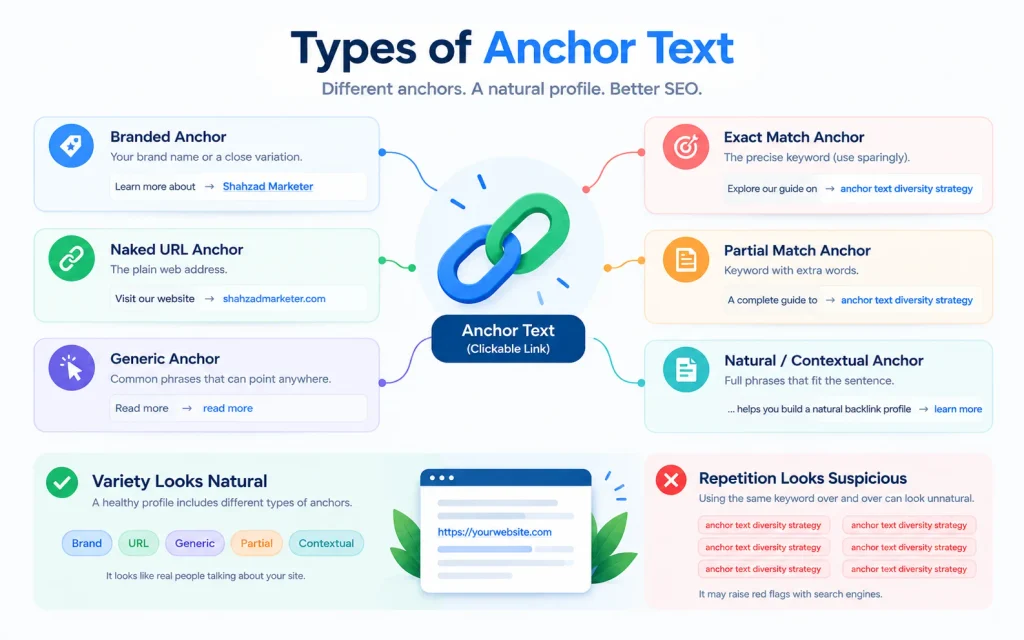
Branded Anchors
Your brand name, or a close version of it.
“Shahzad Marketer” … “according to Shahzad Khan” … “the Shahzad Marketer team”
These are the safest anchors you can have. They’re common in healthy profiles, they build brand recognition, and they’re nearly impossible to over-optimise. Big brands dominate their profiles with branded anchors for a reason.
Naked URL Anchors
Just the raw address. Nothing else.
Real writers do this all the time when citing a source. Naked URLs are easy to get, completely safe, and they add honest variety to your profile. Never turn one down.
Generic Anchors
Phrases that could point anywhere.
“click here” … “read more” … “this guide” … “learn more”
Generic anchors get a bad rap. People assume they’re useless because they don’t contain keywords. Truth is, they show up constantly in real editorial content, and they can water down an otherwise keyword-heavy profile.
Exact-Match Anchors
Your exact target keyword. Word for word.
“anchor text diversity strategy“
Yes, this one carries the strongest signal. That’s exactly why it’s the most abused. A couple of these look normal. A profile full of them looks bought. Handle this type with discipline.
Partial-Match Anchors
Your keyword, wrapped in extra words.
“a practical anchor text diversity strategy” … “how to build anchor text diversity” … “anchor text diversity for beginners”
This is your best friend. The keyword is still there. Google still gets the signal. But it reads as if a human wrote it — because a human did.
Long-Tail and Contextual Anchors
Full phrases where the keyword blends into the sentence.
“a simple way to build a more natural backlink profile”
Real bloggers write anchors like this when they’re genuinely referencing your content. Low risk, and they sound completely believable.
Image Anchors
When someone links through an image, the alt text usually becomes the anchor. It’s a quiet way to add variety — especially if your content has original graphics or charts that people embed.
Compound Anchors
Sometimes types mix together. Brand plus keyword, for instance.
“Shahzad Marketer‘s anchor text guide”
These sit nicely between pure branded and pure exact match. Worth using on purpose in your guest posts.
What Does a Natural Anchor Text Profile Look Like?
Honest answer — it depends on your site.
There is no official Google ratio. Nobody at Google has ever published a chart saying “30% branded, 10% exact match.” If you see an article claiming a perfect percentage, that author is guessing.
Here’s what actually shapes a natural profile:
Your niche. A SaaS company in a competitive market attracts more commercial anchors than a local bakery. That’s just how it goes.
Your link sources. Guest posts give you control over anchors. Organic mentions and press coverage lean heavily toward branded and URL-based. Digital PR even more so.
Your domain’s authority. Established sites can handle more aggressive anchors because the rest of their profile supports them.
How the links were earned. A profile built through outreach looks different from one built through genuine mentions.
So instead of chasing a ratio, look at the shape of your profile.
In most healthy ones, branded and generic anchors form the biggest chunk. URLs and partial matches sit in the middle. Exact match hangs out at the small end — present, but never dominant.
If yours looks like that, you’re fine. If the first thing you see is a wall of identical money keywords, keep reading.
How to Build Your Anchor Text Diversity Strategy
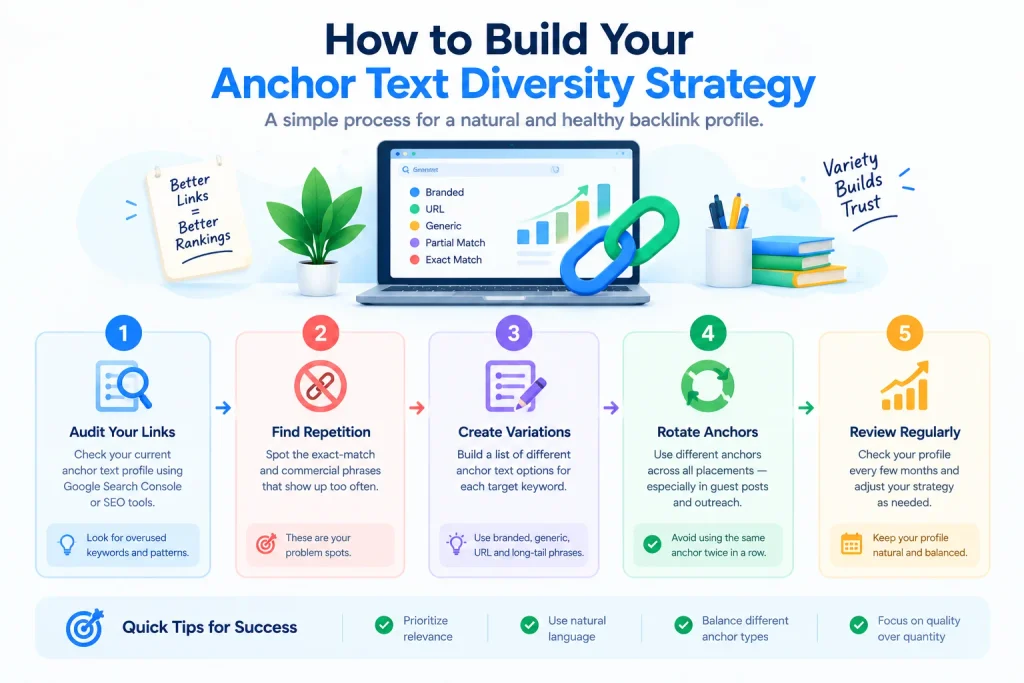
Here’s the framework I recommend, in order of priority.
Make branded anchors your default. When you request or place a link, the brand name comes first. It’s safe, natural, and builds your brand at the same time.
Let URLs and generic phrases work. Don’t reject a “read more” link or a plain URL placement. Those links do quiet, important work — they keep your profile believable.
Use partial match when you want relevance. Need the keyword signal? Wrap it in a longer phrase. You keep the topical connection without sounding robotic.
Save exact match for rare moments. Sometimes a sentence genuinely calls for the exact phrase. Use it then. Don’t force it everywhere else.
Match the anchor to the destination page. If the link points to a guide about anchor text, the anchor should describe that guide. Not your homepage’s sales pitch.
Let the linking page’s context lead. A natural sentence on a relevant article beats a perfect keyword on an unrelated site.
Vary everything across campaigns. Ten guest posts this month? Those ten anchors should be ten different phrases. Rotate between brand, partial match, URL, and natural language on purpose.
A lot of profiles go sideways right here. Not from one bad link — from repeating the same request across dozens of them. If you’re doing outreach at scale, anchor variety belongs in your process from day one, not as an afterthought.
And if you’re not sure what your current profile even looks like, start there. Our guide on how to check backlinks of a website walks through the tools and the exact steps.
Exact Match vs. Partial Match Anchor Text
People always ask which one “works better.”
They do different jobs, honestly.
Exact match sends the clearest signal. “Anchor text diversity strategy” tells Google exactly what the page targets. But that clarity cuts both ways — repeated exact-match anchors make the manipulation obvious.
Partial match sends a softer signal, but it blends in. “A simple anchor text diversity strategy for small sites” still has the keyword. Google still understands the page. But it reads as if a person wrote it.
Here’s a trick. Read the sentence out loud.
If the exact phrase makes you cringe even slightly, use the partial version. Your instinct is usually right.
How Many Exact Match Anchors Should You Use?
There’s no safe number. Anyone who gives you one is making it up.
What you have instead is context — and a few better questions.
Does this anchor fit the sentence naturally? Is the linking page actually relevant? Have I used this exact phrase on other recent links? Would a branded or partial-match version work just as well?
A strong, established site in a competitive niche can carry more commercial anchors. The rest of its profile backs it up. A newer site with a thin link profile should play it safe.
When in doubt, pick the safer anchor. You lose nothing by doing that.
How to Diversify Anchor Text Naturally
Alright, the practical part. Here’s the process:
Step 1 — Pull your current anchor data. Google Search Console shows your top linking text for free in the Links report. Tools like Ahrefs or Semrush give you the full picture, including anchors Google may not have indexed yet.
Step 2 — List your most repeated anchors. Look for exact-match or commercial phrases showing up over and over. Those are your problem spots.
Step 3 — Build a variation bank. For each target keyword, write ten alternatives. Partial match, long-tail, brand-plus-keyword, question-style anchors. Keep this list next to you whenever you write or request links.
Step 4 — Rotate across placements. Never use the same anchor twice in a row. One guest post uses your brand name, the next uses partial match, the one after that a URL.
Step 5 — Accept the “boring” anchors. When a site links to you with your URL or a generic phrase, that’s not a failed link. That’s a natural link. Say thanks and move on.
Step 6 — Fix what you control. For guest posts and outreach, you influence the anchor — so use that influence for variety, not repetition.
Step 7 — Review every few months. Profiles drift. A quarterly check stops small issues from turning into patterns.
If a guest posting campaign is in your plans, this is where strategy beats volume. Ten placements with varied, natural anchors outperform fifty with the same keyword repeated. Our post on how to find guest post opportunities helps you target the right sites from the start, and our list of link building mistakes to avoid covers the habits — like stuffing exact-match keywords everywhere — that quietly drag profiles down.
Common Anchor Text Mistakes to Avoid
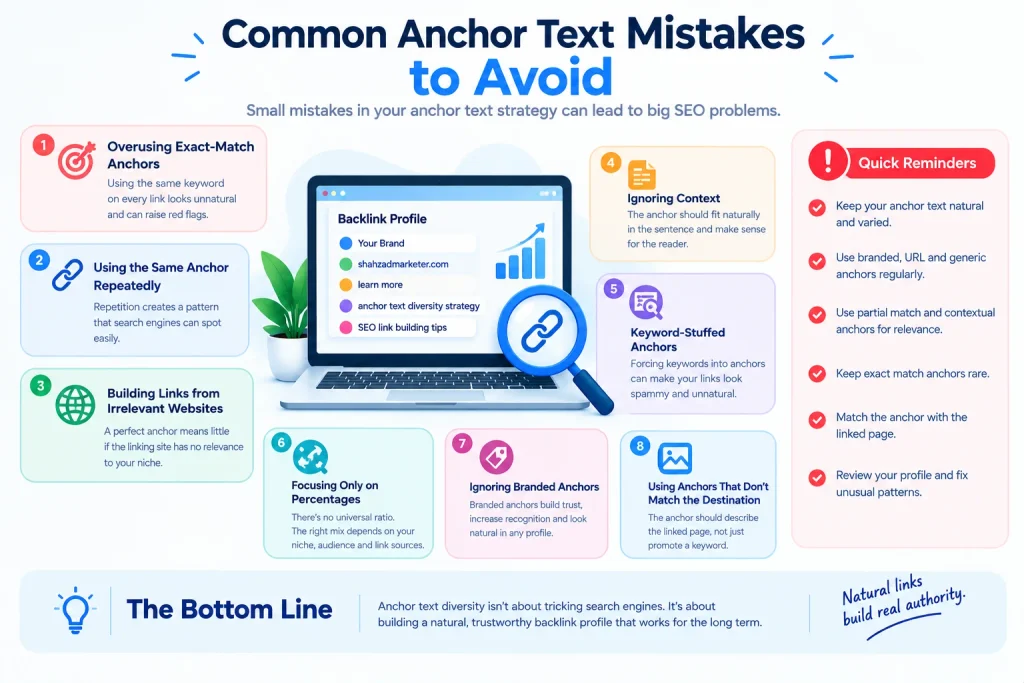
Most anchor problems come from a handful of repeatable mistakes:
Using the same exact-match phrase on every new link. This is the big one. Repetition turns a strategy into a footprint.
Ignoring branded and generic anchors. Skip them, and your profile gets top-heavy with commercial phrases.
Forcing keywords into sentences that don’t want them. If the anchor breaks the flow, it’s wrong — no matter how good the keyword is.
Chasing irrelevant sites for the sake of an anchor. A perfect keyword on an unrelated site is worth less than a brand mention on a relevant one.
Treating percentages as law. Worry less about hitting a ratio. Ask “does this look natural?” instead.
Mismatching anchor and destination. An anchor about SEO services pointing to a WordPress speed post confuses everyone — readers and Google alike.
Handling internal links like external ones. More on this in a minute.
Forgetting image alt text. Linked images without alt text waste an anchor opportunity. Stuffed alt text creates a spammy one. There’s a right middle ground.
How to Analyse Your Existing Anchor Text Profile
Time to look under the hood. Here’s what to review.
Anchor distribution. What are your top ten most-used anchors? If one commercial phrase dominates, you found your first fix.
Branded vs. commercial balance. What share of your profile is brand-based? If it’s tiny, your priority is earning more brand mentions and URL links.
Linking page quality. Open the pages behind your most aggressive anchors. A keyword-stuffed anchor from a spammy directory is a double problem.
Relevance. Are the linking pages actually about your topic? Irrelevant anchors from irrelevant pages don’t become safe just because the phrasing sounds natural.
Link attributes. Check whether key links are dofollow or nofollow. Both belong in a natural profile — Google has treated nofollow as a hint, not a hard stop, for years now. A profile with only dofollow links looks just as strange as one with only exact-match anchors. We covered attributes in detail in our link building for SaaS companies guide, and the same logic applies to any niche.
What if you find something serious? Hundreds of identical money anchors from obviously paid placements, that kind of thing.
Then the conversation shifts. You’re looking at Google’s guidance on qualifying links, and in extreme cases, the disavow tool. For most sites, though, the fix is simpler — build better, more varied links from now on.
A Realistic Anchor Text Diversity Example
Let’s make this concrete. Fictional example, by the way — an illustration, not a case study.
Imagine a site called BrightCart that sells budgeting software. Here’s what a natural spread of anchors to its product page might look like:
“BrightCart” — branded “brightcart.com” — naked URL “this budgeting app” — generic “budgeting software for freelancers” — partial match “a simple way to track freelance income” — long-tail contextual “best budgeting software” — exact match, only a few times across the entire profile “BrightCart’s expense tracking features” — brand-plus-keyword compound
See the shape? Most of the links are brand, URL, and natural phrases. The commercial exact match is a small sliver — clearly not the campaign’s goal.
Now picture BrightCart’s competitor. Forty per cent of that profile says “best budgeting software.”
Which one looks arranged to you? That’s the same thing Google’s systems see.
Anchor Text Diversity in Guest Posting and Link Building
Guest posting gives you something most link building doesn’t — control.
When you write or commission a guest post, you usually decide where the links go and what the anchors say. Useful, yes. But slightly dangerous too, because over-optimisation becomes very easy to do by accident.
A few rules for placements you control:
Rotate anchors across every placement. Build your variation bank before the campaign, not after.
Make the surrounding paragraph earn the link. The sentence before and after should explain why the link is worth clicking. That context is what separates an editorial link from an inserted one.
Accept editorial changes. If an editor swaps your exact-match anchor for a branded one, that’s not a loss. That’s the link becoming more natural.
Think topical, not just textual. Relevant content on a relevant site carries the keyword signal even when the anchor itself is just your brand name.
This is the white-hat philosophy in practice — links earned through relevant, useful content on real publications. If you’d rather have placements handled for you, with anchor diversity built in from the start, take a look at how our guest posting and link building services work. Or browse the verified publications we work with directly.
Internal Links Play by Different Rules
One thing trips people up here, so let me clarify.
Everything above applies to external backlinks. Internal links — the ones between your own pages — are a different game.
You control both sides of an internal link. So Google reads it mainly for site structure and navigation. Descriptive, keyword-informed internal anchors are fine. Genuinely helpful, actually.
If this article links to another guide using the anchor “how to check backlinks of a website,” that’s natural internal linking doing its job.
So yes — be descriptive and connect your related content internally. Then save the caution for links you don’t fully control.
Best Practices for a Natural Anchor Text Strategy
Quick checklist. Save this one:
- Quality and relevance of the linking page come first, always
- Branded anchors are your default foundation
- Welcome naked URLs and generic anchors — they add natural variety
- Use partial match and long-tail phrases when you want topical signals
- Keep exact match rare, and only where it genuinely fits
- Never repeat the same anchor across consecutive placements
- Match every anchor to the content of its destination page
- Review your anchor distribution every three to four months
- Build your variation bank before any outreach campaign starts
- Write for the reader first — the natural anchor usually follows
Frequently Asked Questions
What is anchor text diversity? It’s using a mix of anchor types — branded, generic, URLs, partial match, exact match, natural phrases — across your backlinks, so the profile looks organic rather than manipulated.
Why is anchor text diversity important? Because search engines read patterns. A profile where the same commercial keyword repeats forever looks arranged, and arranged links fall under spam policies. Variety keeps things natural and lowers that risk.
How do you diversify anchor text? Review your current anchors, spot the overused phrases, build a list of variations for each target keyword, and rotate those variations across every new placement. Accept branded and generic anchors instead of pushing for keywords every time.
What is a natural anchor text profile? One where branded, URL, and generic anchors make up the biggest share, partial match and contextual phrases fill the middle, and exact-match anchors show up only occasionally. No obvious repetitive pattern.
Should you use exact match anchor text? Occasionally, yes — when the phrase genuinely fits the sentence and your profile can support it. If the sentence sounds forced with the exact phrase, go with partial match or branded.
What’s the difference between exact match and partial match? Exact match uses the precise keyword alone. Partial match includes the keyword with extra words around it — same signal, but it reads more naturally.
How do you analyse anchor text distribution? Use Google Search Console’s Links report for your own site — it’s free. Ahrefs or Semrush give you the full picture across all your backlinks. Check your most frequent anchors, the branded-to-commercial balance, and the pages behind your most aggressive anchors.
Can over-optimised anchor text hurt SEO? Yes. A clear pattern of repetitive, forced exact-match anchors can trigger unnatural link signals — exactly what Google’s spam systems watch for. One or two exact-match links are fine. Patterns are the problem.
Final Thoughts
Anchor text diversity isn’t really an SEO trick. It’s honesty, applied to link building.
Real websites mention brands in different ways, in different sentences, for different reasons. When your backlink profile reflects that, you stop stressing about algorithm updates. There’s nothing artificial to catch.
So start with your foundation. Branded anchors, URL links, natural phrases. Add partial match where relevance matters. Keep exact match rare and purposeful. Check your profile every few months.
That’s the whole strategy. And it works because it’s not a trick at all.
Want a second pair of eyes on your current anchor profile? Or a guest posting campaign built with this kind of natural variation from day one? Reach out through shahzadmarketer.com. We’ll look at your actual data first, then build from there.
Get in Touch
Questions about guest posting, press releases, or getting your brand featured on premium publications? Shahzad is available directly through the channels below:
Email: shahzad@shahzadmarketer.com
LinkedIn: https://www.linkedin.com/in/shahzadmarketer/
WhatsApp: +44 7848 475000
Website: https://shahzadmarketer.com