Link Building for SaaS Companies: 10 Strategies to Build Quality Backlinks
Backlinks still matter. A lot.
But here is the truth. SaaS link building is different. You sell software. Not shoes. Your site has product pages, feature pages, and integration pages. These need links too. Not just your blog.
So how do you actually build quality backlinks for a SaaS company?
This guide shows you exactly how. We will cover ten practical strategies. No fluff. No generic advice. Just what works.
What Is Link Building for SaaS Companies?
Link building means getting other websites to link to yours. For SaaS companies, these links point to your software website.
That is it. Nothing complicated.
What Is a SaaS Backlink?
It is a link from another site to your SaaS website. It can point to your homepage. It can point to a product page. It can even point to a free tool you built.
Here is an example. A project management blog links to your task-management software. That is a SaaS backlink. Simple, right?
Why SaaS Link Building Is Different
SaaS websites are not like normal business sites. A local plumber has service pages and a blog. A SaaS company has much more.
You have product pages. You have feature pages. You have integration pages, comparison pages, templates, free tools, research, and educational content.
This gives you more chances to earn links. But it also makes things more complex. You need links to pages that convert visitors. Not just your blog.
What Makes a Good SaaS Backlink?
A good backlink is not just about a high score from a third-party tool. Here is what actually matters.
Relevance. The linking site should be in your industry.
Website quality. The site should have real content and real traffic.
Audience fit. The readers should be people who might buy your software.
Editorial context. The link should appear naturally in useful content.
Useful placement. The link should help the reader.
Natural anchor text. The clickable text should not look forced.
A link from a small but relevant SaaS blog can beat a link from a huge unrelated site. So do not chase size. Chase relevance.
Why Is Link Building Important for SaaS Companies?
Backlinks help your SEO in many ways. But let us be real. One backlink will not shoot you to page one.
Improve Organic Visibility
Quality backlinks help search engines find and trust your pages. Over time, this can improve your visibility.
However, it works best with good content and solid technical SEO. Links alone are not enough.
Build Website Authority and Trust
When relevant sites link to you, it sends a signal. It tells search engines your site is worth referencing. It tells customers that others trust you.
This takes time. It does not happen overnight.
Earn Referral Traffic
A link on a popular industry blog can send real visitors to your site. These visitors already care about your niche. So they are more likely to sign up for a trial.
Referral traffic is often ignored. But it can be highly qualified.
Support Important SaaS Pages
Most SaaS companies only build links to their blog. That is a mistake.
You can build links to many pages. These include product pages, feature pages, and guides. You can also build links to research, tools, comparison content, and integration pages.
Links to these pages help them rank. They also help visitors find your product directly.
Build Brand Awareness
When industry sites mention your brand, more people learn about you. Even if they do not click, they see your name. Over time, this builds familiarity.
Familiarity leads to trust. And trust leads to signups.
10 Best Link Building Strategies for SaaS Companies
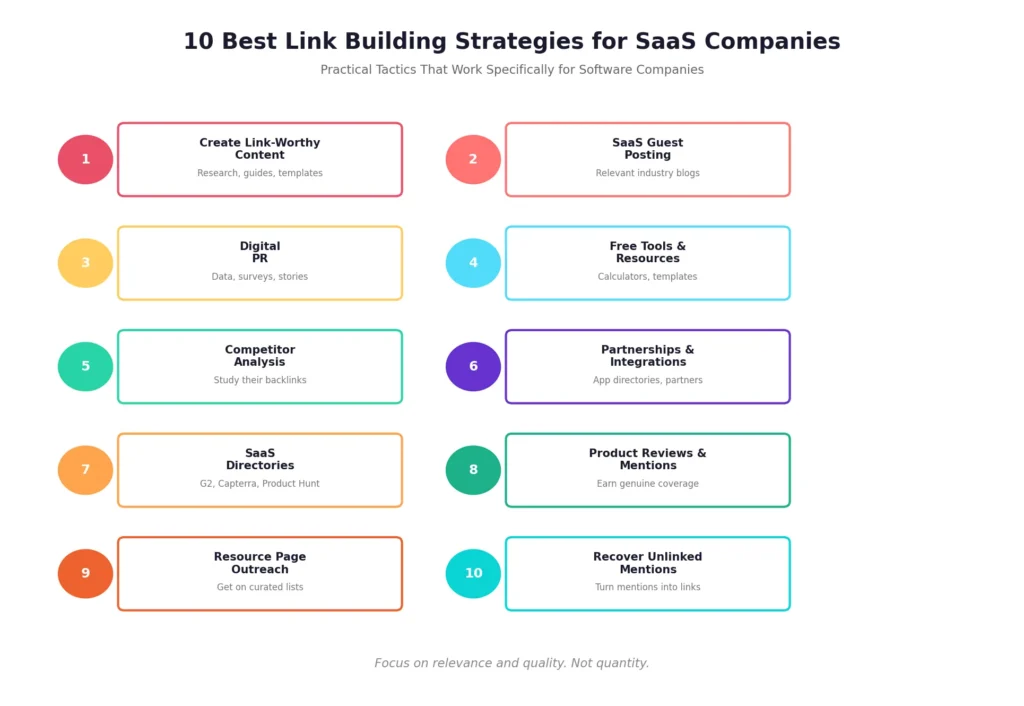
These tactics work specifically for SaaS companies. They are not random. Let us dive in.
1. Create Link-Worthy SaaS Content
Useful content attracts links naturally. But it must solve a real problem. Do not create content just for links.
Here are content types that work.
Original research. Survey your users. Publish the results. No one else has this data.
Industry reports. Compile trends from your niche.
Statistics pages. Collect industry stats. Writers love linking to these.
Detailed guides. Go deeper than anyone else on a topic.
Templates. A project management SaaS can offer planning templates.
Checklists. A marketing SaaS can offer campaign checklists.
Case studies. Show real results from real customers.
Data studies. Analyze public data. Share unique insights.
Buffer publishes annual social media statistics. Those pages earn thousands of backlinks. Why? Because writers need stats. Buffer has them.
Your content should answer a question your audience actually asks.
2. Use SaaS Guest Posting
Guest posting still works. But only when done right. The goal is not volume. The goal is reaching the right audience.
Here is how to do it properly.
First, find relevant publications. Look for blogs your target customers actually read.
Next, check website quality. Read recent posts. Is the content good? Is there engagement?
Then, choose useful topics. Pitch ideas that help their readers. Not ideas that only promote your product.
After that, write helpful content. Share real insights. Do not write a 500-word ad.
Finally, use natural anchor text. Link to your site where it makes sense.
One guest post on a respected SaaS blog beats ten posts on random sites. So avoid mass guest posting on unrelated websites.
3. Build Links Through Digital PR
Digital PR means creating stories journalists want to cover. For SaaS, this often means data.
Here are ideas that actually work.
Run original research. Survey 500 users. Publish the findings.
Compile industry statistics. Gather data no one else has collected.
Send surveys. Ask your audience about their biggest challenges.
Share product trends. Use insights from your platform data.
Offer expert commentary. Let your CEO speak as a source for industry stories.
Launch new studies. Partner with a research firm if needed.
Share unique company data. If you run a CRM, what can you share about sales trends?
Original data is more linkable than opinion pieces. A journalist can quote your research. They cannot quote your generic blog post.
4. Create Free Tools, Templates, and Resources
SaaS companies have a huge advantage here. You can build tools. Other businesses cannot.
Here are examples.
Calculators. Pricing calculators. ROI calculators.
Templates. Spreadsheets, documents, or Notion templates.
Checklists. Printable lists.
Generators. Title generators. Email subject line generators.
Free mini-tools. A keyword research tool. A headline analyzer.
Worksheets. Planning worksheets.
Planning resources. Budget planners. Content calendars.
CoSchedule has a headline analyzer. It is free. It earns backlinks constantly. Why? Because it is genuinely useful.
Do not build a tool just for links. Build it because your audience needs it. The links will follow naturally.
5. Use Competitor Backlink Analysis
Your competitors have backlinks. Some of those links could be yours too.
Follow this process.
First, identify relevant competitors. Look at companies your size. Not just the biggest player.
Next, analyze their referring domains. Use a backlink tool to see who links to them.
Then, find useful backlinks. Look for links from blogs, directories, and resource pages.
After that, look for common links. If three competitors have a link from the same site, you probably belong there too.
Now, qualify each prospect. Is the site relevant? Is the content good?
Finally, decide if it makes sense. Not every competitor link is worth copying.
Some links come from relationships you do not have. Some are from low-quality sites. Always check first.
6. Build Links Through SaaS Partnerships and Integrations
This is a SaaS-specific strategy many companies ignore.
You have integration partners. You might work with agencies, resellers, or affiliates. These relationships can lead to natural links.
Here are the opportunities.
Integration partners. If your CRM integrates with Slack, Slack might list you in their app directory. That is a backlink.
App marketplaces. Get listed on Zapier, HubSpot, or Salesforce.
Technology partners. Partners often have partner pages. Ask for a link.
Agencies. Agencies that use your software might list you as a recommended tool.
Resellers. Reseller partners can mention you on their site.
Affiliates. Affiliate partners create content about your product.
Customers. Happy customers might mention you in case studies.
Industry partners. Co-marketing campaigns often lead to mutual links.
These links are natural. They make sense for the user. That is exactly what Google wants to see.
7. Get Listed on Relevant SaaS and Industry Directories
Directories still matter. But quality beats quantity every time.
Focus on these.
SaaS directories.G2, Capterra, Product Hunt, SaaSworthy.
Industry directories. Niche directories for your field.
Software marketplaces. App stores and integration directories.
Professional organizations. Industry associations with member directories.
Niche business directories. Relevant local or industry-specific lists.
Do not submit to hundreds of random directories. That wastes time. It can even hurt you.
Focus on directories your customers actually use. A listing on G2 is valuable. A listing on a directory no one knows is not.
8. Earn Product Reviews and SaaS Mentions
Reviews from trusted sources carry weight.
Target these types of sites.
SaaS reviewers. Bloggers who review software.
Industry bloggers. Writers who cover your niche.
Technology publications. TechCrunch, VentureBeat, or niche publications.
YouTube creators. SaaS reviewers on YouTube often link in descriptions.
Comparison websites. Sites that compare tools in your category.
Software roundups. “Best CRM software” or “Top project management tools” lists.
Focus on genuine coverage. Reach out to reviewers who already cover your space. Offer a trial. Answer their questions.
Do not ask for a positive review. Ask for an honest one.
Fake reviews backfire. Always.
9. Use Resource Page and Editorial Outreach
Some websites already list useful resources. Your job is to get on those pages.
Look for these.
Industry resource pages. “Best resources for marketers” or “Top tools for developers.”
Recommended tools pages. Bloggers often have a “tools we use” page.
Marketing resources. Educational sites with resource sections.
Educational guides. University or training sites that link to tools.
Software lists. Curated lists of software in your category.
Here is how to pitch.
Find the page owner. Send a short, personalized email. Mention something specific about their site. Explain why your resource fits their page.
Do not use spammy templates.
If your free template helps their readers, they might add it. If it does not, no pitch will work.
10. Recover Lost or Unlinked Brand Mentions
You are already being mentioned online. Some mentions have no link. Some old links have disappeared.
Lost Backlinks
Use a backlink tool to find links that used to point to your site but no longer do. Maybe a site redesigned and removed your link. Maybe a page was deleted.
Reach out politely. Ask if they can restore the link. Sometimes they will.
Unlinked Brand Mentions
Use a mention tracking tool to find sites that mention your company without linking. Send a friendly email. Thank them for the mention. Ask if they would add a link.
Not every mention should become a link. Some sites do not link to anyone. Some mentions are in contexts where a link does not fit. So be selective.
How to Build a SaaS Link-Building Strategy Step by Step
Random link building fails. You need a real strategy.
Step 1 — Define Your SEO Goals
What do you want?
More organic visibility? Links to important pages? Brand awareness? Referral traffic? Content growth?
Your goals shape your tactics. If you need product page links, guest posting alone might not work. You might need partnerships or directory listings.
Step 2 — Analyze Your Existing Backlinks
Before building new links, know what you have.
Check your referring domains. Look at your strongest backlinks. Review your anchor text distribution. See which pages get the most links. Find new backlinks from recent months. And check for lost backlinks.
This shows what is working. It also shows gaps.
Step 3 — Analyze Competitors
Pick three to five competitors. Look at their referring domains. Find sites that link to multiple competitors. Study their strongest content assets. Look for their guest posting opportunities. Find industry publications that cover them.
This gives you a starting list.
Step 4 — Create Linkable Assets
You need something worth linking to. Build comprehensive guides. Run original research. Create free tools. Design templates. Gather unique data. Publish case studies.
Without assets, your outreach will fail. No one links to a generic product page unless they already love your product.
Step 5 — Build a Qualified Prospect List
Do not collect a thousand random sites. Check each one carefully.
Is it relevant? Is the quality high? Does the audience match yours? Is the content good? Would a link there make sense?
Fifty qualified prospects beat five hundred random ones.
Step 6 — Start Outreach
Write short, personalized emails. Mention something specific about their site. Explain why your resource helps their readers.
Avoid mass templates. Avoid spam follow-ups. One polite email is enough. A second follow-up is fine. Three or more is pushy.
Step 7 — Track Results
Monitor your progress monthly.
Track new referring domains. Count new backlinks. Watch for lost backlinks. Measure referral traffic from new links. Check organic visibility changes. And review performance of target pages.
Link building takes time. So track monthly, not daily.
How to Find SaaS Link-Building Opportunities
Here is a practical process you can follow today.
Find Websites in Your SaaS Niche
Search for blogs, publications, and communities in your industry. Try these searches. Search for “best project management software.” Search for “email marketing blog.” Or search for “SaaS resources.”
Research Competitor Backlinks
Use a backlink analysis tool. Export competitor referring domains. Filter for relevant sites.
Find Industry Publications
Look for online magazines, news sites, and blogs that cover your industry regularly.
Find Relevant Resource Pages
Search for “marketing resources” or “developer tools” or “recommended tools for agencies.”
Find SaaS Review and Comparison Websites
Search for “best CRM software” or “HR software reviews” or “project management comparison.”
Find Integration and Partnership Opportunities
Check your integration partners’ websites. Look for partner directories, app marketplaces, and co-marketing chances.
Find Unlinked Brand Mentions
Set up Google Alerts for your brand name. Check each mention for a link.
Always qualify opportunities. A huge list of unqualified sites is useless.
How to Evaluate a Backlink Opportunity
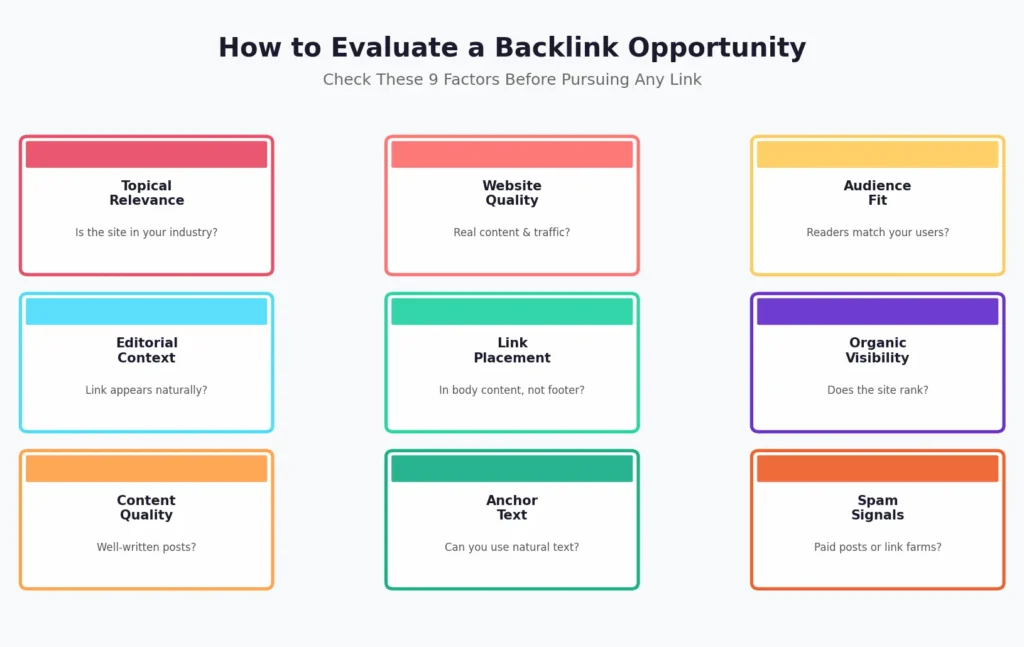
Use this framework before pursuing any link.
Topical Relevance
Does the site cover topics related to your SaaS? A marketing blog linking to your email tool is relevant. A cooking blog is not.
Website Quality
Does the site have real content? Real authors? Regular updates? Or is it a thin site built only for links?
Audience Relevance
Will the readers care about your product? If not, the link has little value.
Editorial Context
Is the link inside useful content? Or stuffed into a random paragraph?
Link Placement
Is the link in the body of the article? Or hidden in a footer or sidebar?
Body content links are generally stronger.
Organic Visibility
Does the site rank for anything? If a site gets no traffic, it might not be valuable.
Content Quality
Read a few posts. Are they well-written? Do they provide value? Or are they thin and keyword-stuffed?
Anchor Text
Can you use natural anchor text? Or does the site force exact-match keywords?
Overall Spam Signals
Does the site publish obvious paid posts? Does it have too many outbound links? Does it feel like a link farm?
Important: Do not rely only on Domain Authority or Domain Rating. These are third-party metrics. They help with comparison. But they are not official Google scores. A low-DA site with high relevance can beat a high-DA site with no audience.
SaaS Anchor Text Strategy
Anchor text should look natural. Here are the types to know.
Branded Anchor Text
Example: Shahzad Marketer
This is the safest type. Use it often.
Partial-Match Anchors
Example: SaaS link-building strategy
This includes your keyword naturally. It is useful. But do not overdo it.
Exact-Match Anchors
Example: link building for SaaS companies
Use these sparingly. Too many look manipulative. Google has penalized sites for this.
Naked URL Anchors
Example: https://www.example.com
These are natural. People paste URLs directly. A healthy profile includes some of these.
Generic Anchors
Examples: “Learn more” or “Read the guide” or “Visit the website” or “Click here.”
These are common and natural. Do not avoid them.
A natural backlink profile mixes all these types. Do not try to control every anchor. That is not how real links work.
Common SaaS Link-Building Mistakes to Avoid
Here are mistakes that waste time or hurt your SEO.
Buying cheap backlinks in bulk. These come from spammy sites. They can trigger penalties.
Building links from irrelevant sites. An unrelated link does not help. It might hurt.
Focusing only on DA or DR. These metrics are estimates. Not the full picture.
Overusing exact-match anchor text. This looks unnatural and risky.
Publishing guest posts on unrelated sites. Reach matters more than volume.
Copying competitor backlinks blindly. Your competitors might have bad links too.
Ignoring link relevance. A relevant link from a small site beats an irrelevant link from a big one.
Creating content only for backlinks. Content should help users first. Links are a side effect.
Using automated spammy outreach. Mass emails get ignored. They damage your brand.
Ignoring lost backlinks. You might be losing valuable links without knowing.
Ignoring existing brand mentions. These are the easiest links to get.
Measuring success only by backlink count. Ten great links beat a hundred weak ones.
Avoid these. Focus on quality and relevance.
How Many Backlinks Does a SaaS Company Need?
There is no magic number. It depends on many factors.
Your industry. Your competition. Your website age. Your content quality. Search demand for your topics. Competitor backlink profiles. Your existing authority. The quality of referring domains.
A new startup in a competitive space might need more links than an established company in a small niche. But the number itself does not matter.
What matters is this. Are your backlinks helping you rank? Are they driving referral traffic? Are they building authority?
Do not chase a backlink target. Chase results.
How to Measure the Success of SaaS Link Building
Track metrics that actually matter.
Relevant referring domains. Are you earning links from sites in your niche? Relevance beats volume.
Quality backlinks. Are the links from real, trusted sites? Or from link farms?
Organic search visibility. Is your site showing up for more searches? Are rankings improving?
Referral traffic. Are people clicking your links and visiting your site?
Rankings for important topics. Are your target pages ranking better for key terms?
Leads and conversions. Are visitors from backlinks signing up for trials? Becoming customers?
Brand mentions. Are more people talking about your brand?
Remember this. Backlinks are not the final goal. The goal is qualified traffic, visibility, leads, and customers. Links are just a tool to get there.
SaaS Link Building Workflow
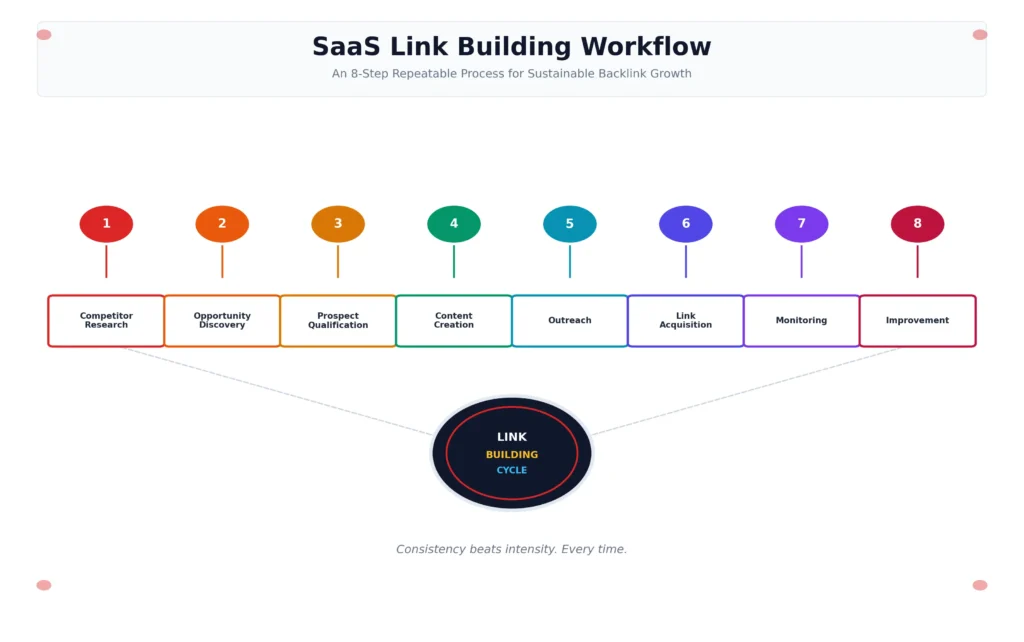
Follow this cycle.
Competitor Research → Opportunity Discovery → Prospect Qualification → Content Creation → Outreach → Link Acquisition → Monitoring → Improvement
Competitor Research shows what works in your space.
Opportunity Discovery helps you find sites and partnerships that could link to you.
Prospect Qualification filters out low-quality chances.
Content Creation builds something worth linking to.
Outreach contacts prospects with personalized messages.
Link Acquisition earns the link.
Monitoring tracks new and lost backlinks.
Improvement means learning what works. Then doing more of it.
This is a cycle. Not a one-time project.
Frequently Asked Questions
What is link building for SaaS companies?
It means earning backlinks to your SaaS website. These links improve SEO. They also drive referral traffic and build authority.
How do SaaS companies build backlinks?
They create useful content. They build free tools. They form partnerships. They get listed in directories. They earn reviews. They reach out to relevant sites.
What are the best link-building strategies for SaaS?
The best ones are practical. Create linkable assets. Write guest posts for industry blogs. Run digital PR. Build free tools. Study competitors. Form partnerships. Get directory listings. Earn reviews. Do resource page outreach. And recover unlinked mentions.
Is guest posting good for SaaS SEO?
Yes, when done right. Focus on relevant, quality publications. Write helpful content. Avoid mass guest posting on unrelated sites.
How can a SaaS startup build backlinks with a small budget?
Create free tools or templates. Reach out to integration partners. Get listed in free directories. Build relationships with industry bloggers. Focus on quality, not quantity.
How do I find SaaS backlink opportunities?
Research competitor backlinks. Find industry publications. Search for resource pages. Look for review sites. Explore partnerships. Track unlinked brand mentions.
How many backlinks does a SaaS website need?
There is no fixed number. It depends on your competition and goals. Focus on earning quality, relevant links. Do not chase a number.
Are SaaS directory links useful?
Yes, if the directory is relevant and reputable. Listings on G2 and Capterra can drive traffic. Avoid low-quality directories.
Are nofollow backlinks useful for SaaS companies?
Yes. Nofollow links drive referral traffic. They build brand awareness. They also create a natural profile. Google may use some nofollow links for ranking.
How long does SaaS link building take?
It varies. Directory listings can work fast. Digital PR takes months. Link building is long-term. Expect three to six months for significant results.
Final Thoughts
Successful SaaS link building is not about collecting the most backlinks.
It is about building relationships. It is about creating useful resources. And it is about earning mentions that make sense.
One link from a trusted industry blog can beat fifty links from random sites. So focus on relevance. Focus on quality. Focus on your audience.
Do you need help with link building? Professional services can handle the research. They can handle the outreach. And they can handle the execution. The key is finding someone who understands SaaS. Not just SEO.
Pick one strategy from this guide. Master it. Then add another. Consistency beats intensity. Every time.
About the Author
Shahzad Khan — SEO & Digital PR Expert, Founder of shahzadmarketer.com. Helps agencies and businesses get published on top-tier publications and build authority through white-hat link building.
Get in Touch
Questions about guest posting, press releases, or getting your brand featured on premium publications? Shahzad is available directly through the channels below:
Email: shahzad@shahzadmarketer.com
LinkedIn: https://www.linkedin.com/in/shahzadmarketer/
WhatsApp: +44 7848 475000
Website: https://shahzadmarketer.com
Response time: Usually within a few hours during working hours. Custom packages and publication queries welcome.