Press Release for Startup Funding Announcement: What Actually Works (2026)
A founder messaged me a few weeks ago. His seed round had just closed. He raised $2.8 million. He wrote his own press release. He wanted my opinion.
I read it. It needed work. He’s a smart guy. But he made four common mistakes. These mistakes get your email deleted fast. Sometimes a journalist won’t even finish the subject line.
This happens a lot. A round closes. Founders get excited. They grab a template online. They fill in the blanks. They hit send. Then nothing happens.
A press release is not just paperwork. Do it well, and you might land in Forbes or VentureBeat. Do it poorly, and you just add noise to spam folders.
I’ve run this process for over 500 startups. Some campaigns got 40 or more media hits. Others got almost none. The money raised was not the reason. How you did it made the difference.
Let’s look at what works. I’ll also tell you what usually fails.
What a Press Release Actually Does
Here’s something people get wrong. A press release cannot force anyone to write about you. That’s not how it works.
It does something simpler. It gives a busy journalist a reason to care, fast. These people read hundreds of emails a day. They will not dig through your website. You must hand them the story in the first few lines.
Most founders miss this part. A press release is not just for journalists. It is for investors doing research. It is for people who might want to work with you. It is for customers who are still unsure. It is for partners who need one more reason to trust you.
Last year, a client got one placement on Yahoo Finance. This was after his Series B closed. Nothing fancy. Just a standard wire pickup. A few weeks later, an investor replied to his email. This investor had gone quiet for months. He said he saw the news. That reply turned into a term sheet soon after.
The link did not make the difference. The credibility did. His company suddenly looked real. That is the true value here. A good press release builds trust before you even speak to someone.
Get the Headline Right First
I spend more time on the headline than on anything else. You should too.
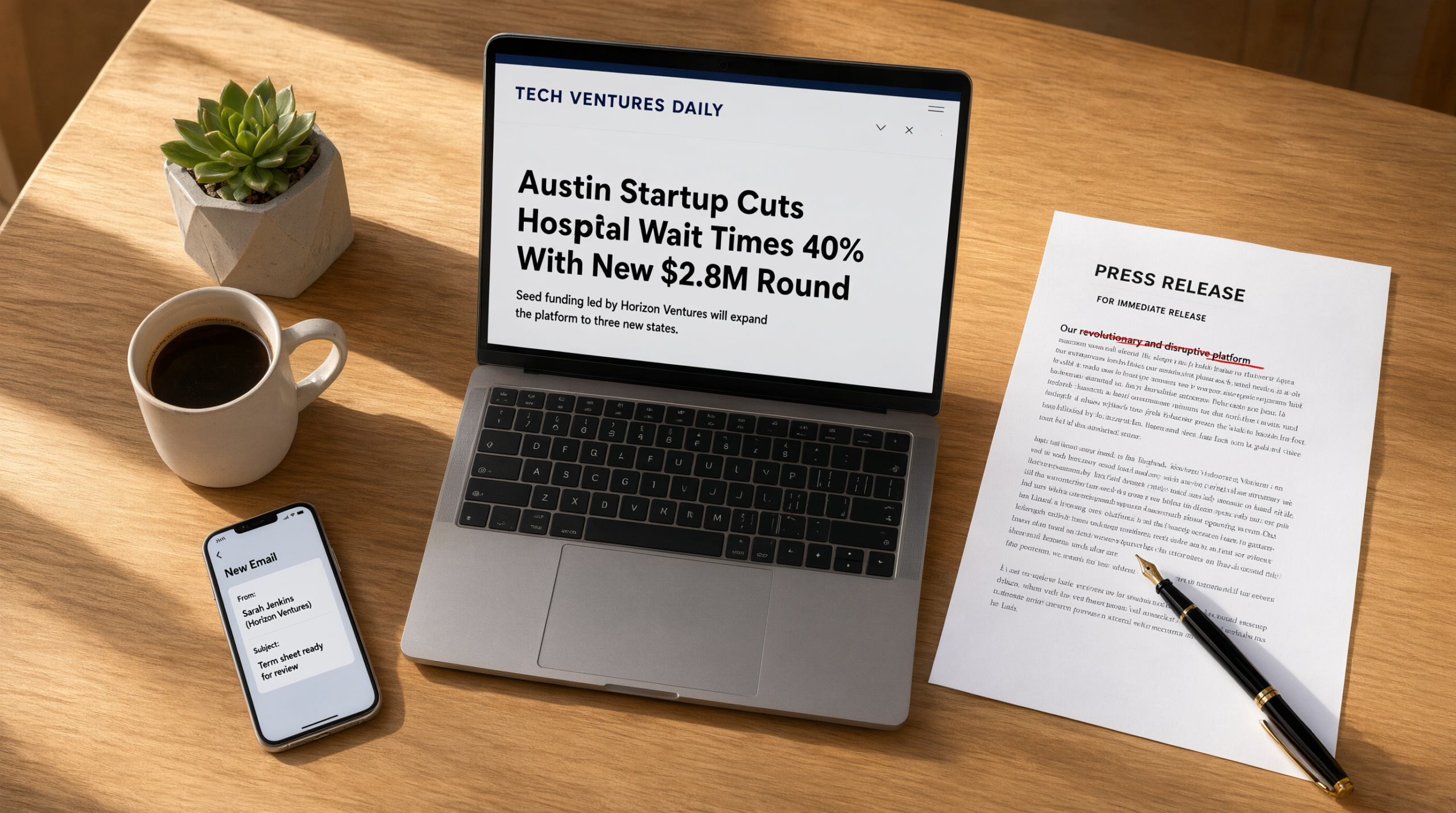
A headline like “XYZ Company Announces Funding Round” tells a journalist nothing. Compare that to this: “Austin Startup Cuts Hospital Wait Times 40% With New $2.8M Round.” Now you have a number. You have a place. You have a real result.
Try this formula. Keep it short:
[Company] raises [amount]. It helps [specific people] fix [one clear problem].
Skip words like “revolutionary” or “disruptive.” Journalists have read those words a thousand times. The words mean nothing now. They often signal you don’t have a real story.
Can you explain your funding round in one plain sentence? If not, stop here first. What problem are you solving? Who are you solving it for? Why does the money matter right now?
What Belongs in the Release
This is news. It is not your life story. Keep it short.
Lead paragraph. Just one. Say who raised what, from whom, and why it matters. If a journalist reads only this, they should still get the full story.
The problem you solve. Be exact. Don’t say “we improve workflows.” Say this instead: “Nurses lose three hours per shift to paperwork.” This gives an editor a real picture.
Your solution. One paragraph. Skip the tech details. Nobody outside your team cares if you use React or Python. They care about the result.
Funding details. Say the amount. Say the round type. Name the lead investor. Say what the money will fund. Naming investors helps. It makes them look good. That often makes them want to help spread the story.
Some proof. Use revenue numbers. Use user growth. Use customer names. Give a sceptical journalist a reason to trust you. No revenue yet? Use waitlist numbers instead.
One founder quote. Just one. It should sound like something you would say out loud. I once saw a quote like this one:
“We are synergistically leveraging our paradigm-shifting platform to disrupt legacy infrastructure.”
I read it three times. I still had no idea what it meant. We rewrote it. The new quote explained why the founder started the company. That version got picked up by three outlets.
Skip future predictions. Skip buzzwords. Don’t list every advisor you have ever met. Skip the “About Us” section too. If a journalist wants that, they will visit your site.
Getting It to the Right People
Writing the release is half the job. Getting it to the right people is the other half. Most founders lose momentum right here.
You have three options.
Do it yourself. Find journalists. Get their contact details. Pitch them directly. This works if you have time and some relationships. Most founders have neither. That means most emails go unanswered. It’s still worth trying if your story is strong. Just expect a lot of silence.
Use a wire service. Services like PR Newswire push your release to hundreds of outlets at once. Most links are nofollow. But you will likely show up on sites like Yahoo Finance within a day. This usually costs a few hundred dollars. It won’t get you TechCrunch. But it builds trust fast. When a customer sees dozens of results about your company, that looks impressive.
Work with someone who has real relationships. This is what we do at shahzadmarketer.com. We write the release. We pitch editors we already know. Most placements go live in three to seven days. Speed matters a lot for funding news. It gets old fast.
Raised $500K or more? This option is usually worth it. Your time is better spent talking to your next investor. Not writing emails that may never get opened.
Timing Matters
Send the release the day your round closes. Not before. Not two weeks later. Funding news loses value fast. Someone else is always announcing a round too.
Aim for Tuesday through Thursday. Send it between 8 and 10 AM Eastern. Skip Fridays. Journalists check out early that day. Skip Mondays too. Their inboxes are already full. Check the calendar as well; if Apple or Google has a big announcement that week, your story may get buried.
I had a client whose board wanted a Friday release. It landed with almost no pickups. It got buried under other emails. We sent the same story again the next Tuesday. Same outlets. This time, we got three placements.
One more thing. Make sure your lead investor will answer the phone. A journalist may call to confirm the round. I know a case where the VC was on vacation. He did not respond for days. By then, the story had moved on.
Mistakes That Kill These Announcements
I have reviewed hundreds of these releases. The same problems show up again and again.
- Leading with the dollar amount, not the problem. “Startup Raises $3M” says very little. “Startup Raises $3M to Help Nurses Spend More Time With Patients” tells a real story.
- Writing for investors, not readers. A press release is not a pitch deck. If an outsider can’t follow it, simplify it.
- Skipping visuals. Add a founder headshot. Add a product screenshot. Visual content gets more attention. It gives editors something to use beyond plain text.
- Ignoring SEO. Include your brand name. Include your founder name. Include terms people search for. This helps your coverage show up later. It is free reputation management that keeps working.
Should You Write It Yourself?
If you write well and know what journalists want, you can do this yourself. But most founders struggle here. They use too much insider language. They assume readers already know the context. Most readers don’t.
A solid press release writer costs $500 to $2500. Distribution costs extra. For a round that took months to close, this is a small cost. Good coverage can bring your next investor. It can bring a strong hire. It can bring a new customer.
At my agency, we handle everything. We write it. We pitch it. We report the results. We have placed funding stories with Forbes, Business Insider, VentureBeat, and AP News. The real skill is not the writing. It is knowing which editor fits your story.
The Bottom Line
A press release is your chance to explain why your company matters right now. It deserves more than a rushed template.
Write a headline that earns a second look. Lead with the problem, not the dollar figure. Pitch the right people. Send it while the news is still fresh.
Want to focus on your next round instead of chasing journalists? That is exactly what we handle at shahzadmarketer.com. We write the release. We pitch it through our editorial network. We deliver live coverage with real traffic. No templates. No guesswork.
Reach out for a free consultation. We will review your angle. We will suggest publications that fit your niche. We will build a timeline around when you need coverage.
About the Author
Shahzad Khan — SEO & Digital PR Expert, Founder of shahzadmarketer.com. Helps agencies and businesses get published on top-tier publications and build authority through white-hat link building.
Get in Touch
Questions about guest posting, press releases, or getting your brand featured on premium publications? Shahzad is available directly through the channels below:
Email: shahzad@shahzadmarketer.com
LinkedIn: https://www.linkedin.com/in/shahzadmarketer/
WhatsApp: +44 7848 475000
Website: https://shahzadmarketer.com
Response time: Usually within a few hours during working hours. Custom packages and publication queries welcome.