
How to Find Guest Post Opportunities in 2026 (7 Methods That Actually Work)
Three years ago, an agency owner from Chicago sent me an email at 11 PM. He’d spent $4,200 on a “premium guest post package” from a vendor he found on Fiverr. The result? Fifteen links on websites with names like “TopHealthBlog247.com” and “TechNewsDailyNow.net.” Zero traffic. Zero ranking movement. His client almost fired him.
I see this story repeat itself constantly. Not because guest posting doesn’t work. It works incredibly well — we’ve published over 10,000 guest posts for more than 500 agencies, and I can show you the ranking reports to prove it. The problem is that most people don’t know where to look for guest post placements that are actually worth their time. They Google “guest post sites,” download a three-year-old PDF list, and blast the same templated pitch to 200 blogs. Then they wonder why nobody replies.
If you’re serious about building real authority through editorial placements, you need a completely different approach. Here’s what actually works in 2026.
Why Most “Guest Post Site Lists” Are a Waste of Your Time
Before I tell you what to do, let me be direct about what not to do. Those massive spreadsheets promising “500+ free guest post sites”? Most are garbage. I’ve downloaded dozens of them. Half the sites don’t accept submissions anymore. A quarter are PBNs that’ll get deindexed next quarter. The remaining ones either have zero traffic or charge $50 for a link that passes about as much authority as a Facebook comment.
Here’s what most guides won’t tell you: finding guest post opportunities isn’t a numbers game. It’s a relevance game. I’d rather have five placements on niche-relevant, actively maintained blogs than fifty links on generic “accept anything” platforms. One of our clients in the SaaS space saw a 40% organic traffic jump after securing just three guest posts on mid-tier but hyper-relevant industry blogs. Meanwhile, another client had 47 links from a bulk package and couldn’t move the needle at all.
The quality of your target list determines everything. So let’s build one properly.
Method 1: Use Google Search Operators (But Be Specific)
Everyone knows about search operators. Almost nobody uses them correctly. Typing “write for us” + your niche into Google will return thousands of results, sure. But most of them are low-quality blogs desperate for free content. You don’t want desperate. You want selective.
Instead, try these exact searches:
"guest post by" + [competitor name]— This shows you exactly where your competitors have already been published. If they got a placement there, you probably can too."contributor" + [your niche] + site:.com— Filters for established sites with actual contributor programs, not random blogs.intitle:"guest post guidelines" + [your niche]— Targets sites that have invested time in creating editorial standards. That’s a good sign.
I found one of our best-performing health niche placements — a DA 68 blog with 200,000 monthly visitors — using the first operator. The site didn’t advertise guest posts anywhere on their homepage. Their “write for us” page was buried in the footer. But a competitor had published there six months earlier. That one search operator saved me probably three hours of manual research.
Method 2: Mine Your Competitors’ Backlinks (The Smart Way)
This is where tools like Ahrefs or SEMrush become worth every penny. But most people use them wrong. They export a competitor’s entire backlink profile — thousands of links — and try to replicate all of them. That’s insane. You’ll drown in data.
Here’s what I do instead. I pick one or two direct competitors who are clearly investing in content and SEO. Then I filter their backlink profile with these exact parameters:
- Dofollow links only (for direct ranking impact)
- DR 40+ (minimum authority threshold)
- Referring domains under 500 (eliminates massive directories)
- Organic traffic: 1,000+ monthly (proves real readership)
- Link type: “Content” (filters out homepage links, footer links, and other non-editorial placements)
What you’re left with is usually a few dozen genuinely viable targets. These are sites that have already accepted content from someone in your space. The editorial door is open. You just need to walk through it with a better pitch.
Last month, I ran this exact process for a fintech client. Filtered thousands of backlinks down to roughly four dozen viable guest post targets. We pitched about a dozen. The majority responded positively. Several placements went live within three weeks. Response rates in the double digits, which is almost unheard of in cold outreach. The secret wasn’t the pitch template. It was the list quality.
Method 3: Use Twitter/X to Find Guest Post Opportunities Before They Disappear
This one sounds ridiculous until you try it. Editors and blog owners announce guest post opportunities on Twitter all the time. They just don’t label them clearly. You need to know what to look for.
Search for these exact phrases:
"looking for contributors""accepting guest posts""writers wanted""contributor guidelines"
Then filter by “Latest” and check results from the past week. I’ve found everything from niche B2B SaaS blogs to major publication contributors soliciting pitches this way.
Here’s a real example. In March, I was scrolling Twitter at 7 AM with coffee (my routine) and saw an editor at a DA 75 marketing blog post: “Need one more contributor for our Q3 content calendar. DM me your pitch.” The tweet was 20 minutes old. I sent a pitch within two hours. She replied in 45 minutes. We had a draft submitted by Thursday. Published the following Tuesday. Ten days from tweet to live link. That placement would’ve taken three months of traditional outreach.
The trick is checking regularly. These opportunities disappear fast. Set a 10-minute daily reminder. It sounds like a small thing, but the ROI is absurd compared to mass email outreach.
Method 4: Build an Editorial Network (The Long Game)
This is the method that separates amateurs from professionals. And honestly, it’s the one that’s built our entire business.
Instead of finding sites, find editors. Specifically, find editors who manage multiple publications or who have moved between publications over time. An editor who approved your pitch at Site A in 2024 might be managing content at Site B in 2026. If you built a genuine relationship, they’ll often prioritise your pitch at the new publication.
Here’s how to track this:
- Check author bios on major publications. Editors often list their Twitter or LinkedIn.
- Follow them. Engage with their content genuinely. Not fake engagement — actual thoughtful comments.
- When they announce a new role or publication, that’s your window.
I’ve been building these relationships for eight years. Our editorial network now spans over 200 publications across 15+ niches. That’s not something you download from a spreadsheet. It’s built one conversation at a time. But even if you’re starting from zero, tracking five to ten editors in your niche and engaging with them consistently for a month will put you ahead of 95% of your competition.
Method 5: Reverse-Image Search Your Infographics (And Follow the Trail)
This one’s niche. But when it works, it works stupidly well. Especially if your team creates visual content like infographics, data visualisations, or comparison charts.
Here’s the exact process I use:
Step 1: Take your best-performing infographic — the one with original data, clean design, and real utility. Upload it to Google Images and run a reverse search.
Step 2: Google will show you every page that has embedded that image. Most of these sites won’t have linked back to you. They’re using your visual content without attribution.
Step 3: Open each result. Check if the site is relevant and has decent authority. If yes, find the editor’s contact info.
Step 4: Send them a simple, non-confrontational email: “Hey, noticed you shared our infographic on [topic]. Glad you found it useful. We’re actually working on a follow-up piece about [related topic] — would you be open to a guest contribution?”
The conversion rate on this approach is absurdly high because the relationship is already warm. They know your brand. They trust your content enough to share it. You’re not a stranger sliding into their inbox.
I did this last year for a client in the cybersecurity space. They had an infographic about ransomware trends that got picked up by over twenty sites. A small handful had linked back. I reached out to most of the rest. Several responded positively. A couple invited guest posts immediately. A few more added proper attribution links. One editor even asked if we could create a monthly column. All from one reverse image search that took maybe 20 minutes.
If you’re not creating visual content, start. Even a simple Canva chart with original data can become a magnet for these kinds of opportunities.
Method 6: Target Resource Pages (The Hidden Goldmine)
Almost every established blog has a “Resources” or “Tools We Recommend” page. These pages link out to authoritative content. If your content is genuinely useful, reaching out to the site owner and suggesting your resource as an addition can lead to either a direct link or — more importantly — an invitation to contribute a full guest post.
But you can’t just blast every resource page you find. You need a system.
Step 1: Use this search operator: "resources" + [your niche] + "recommended" or "useful links" + [your niche]. This surfaces pages that are actively maintained and curated.
Step 2: Vet each page. Does it have recent updates? Are the outbound links to real, active sites? If the page hasn’t been touched in two years, skip it. You’re looking for site owners who still care about that page.
Step 3: Check what content they already link to. Is there a gap your resource fills? For example, if a marketing blog’s resource page links to 15 SEO tools but nothing about link-building outreach, that’s your angle.
Step 4: Send a value-first email. Don’t ask for a link. Offer the resource as something their readers would genuinely benefit from. If they add it, wait two weeks, then follow up with a guest post pitch on a related topic.
One of our clients created a simple but thorough comparison of 20 project management tools. Nothing fancy. Just honest pros and cons. We found over thirty resource pages in the productivity niche that linked to similar content. Reached out to all of them. A handful added the link. A few guest posts. Total time investment: about six hours. Thousands of dollars in equivalent placement value.
The key here is actually having a resource worth linking to. A generic “about us” page won’t cut it. You need a comprehensive guide, a free tool, an original research piece, or a detailed comparison. Something that genuinely helps their readers.
Method 7: Use HARO as a Gateway
HARO gets a bad rap because most people use it wrong. They blast generic responses to every query and wonder why journalists ignore them. But used strategically, HARO is an incredible gateway to guest post opportunities.
Here’s the approach that works: respond to queries in your niche with genuinely useful, quotable insights. When you get featured, follow up with the journalist or editor. Thank them. Offer additional resources. Then, after a week or two, pitch a full guest post on a related topic.
Journalists and editors are overwhelmed with content requests. But they remember people who made their job easier. If your HARO quote was solid and you were easy to work with, they’ll often say yes to a guest post pitch even if their editorial guidelines say they’re “not currently accepting submissions.”
Last fall, I responded to a HARO query about small business SEO trends with a specific data point from one of our campaigns. The journalist included it in her Forbes piece. Two weeks later, I emailed her with a follow-up idea about local SEO strategies for service businesses. She passed it to her editor. We had a guest post approved within four days. Published two weeks after that. The site had officially closed contributor applications six months earlier. But the editor remembered the HARO interaction. That’s the power of this method.
How to Find Guest Post Opportunities Worth Your Time: A Vetting Checklist
Finding opportunities is only half the battle. The other half is knowing which ones to ignore. Here’s my quick vetting checklist:
Check organic traffic, not just Domain Rating. A DR 70 site with 500 monthly visitors is a trap. Use Ahrefs or SimilarWeb to verify real readership. I won’t pitch anything under 2,000 monthly organic visitors unless it’s hyper-niche and growing fast. Run every site through a domain authority checker if you’re unsure — but remember, traffic is the real metric that matters.
Look at recent publish dates. If a blog hasn’t posted in three months, the editor might be inactive. Or the site might be dying. Either way, not worth your time.
Read the last five published posts. Are they well-written? Do they have real comments? Is the author bio section consistent? If the last five posts are all 300-word fluff pieces with keyword-stuffed titles, run.
Check their outbound link profile. Do they link out to legitimate sites? Or is every post stuffed with affiliate links and paid placements? A site that sells links to anyone will eventually get penalised. Your link goes down with it.
Verify the editor is real. Can you find them on LinkedIn? Do they have a real photo and bio? Fake blogs use fake editors. Real publications have real people you can research.
Read their editorial guidelines carefully. If a site doesn’t have any, that’s a red flag. If they do have them, follow them exactly. Editors can spot a copy-paste pitch from someone who never read their guidelines. It’s an instant delete.
The Outreach Reality Nobody Talks About
You can have the perfect target list and still fail. Because finding guest post opportunities is the easy part. Getting a response is where most people quit.
I’ve sent tens of thousands of outreach emails over the years. My first few thousand had a response rate of about 2%. Embarrassing. The recent batches? Around 15-18%. The difference wasn’t the template. It was the research.
Here’s what changed: I stopped sending pitches to sites. I started sending pitches to people. Every cold outreach email referenced something specific — a recent article they published, a topic they’d clearly been focusing on, a gap in their content I could fill. I made it obvious I’d actually read their blog, not just scraped their email from a database.
Most guides tell you to “personalise your pitch.” That’s vague advice. Here’s what personalisation actually looks like: “I noticed your series on B2B SaaS pricing strategies stopped after Part 3. I just finished a case study on how we helped a client increase pricing page conversions by 34% using a completely different framework. Would you be open to a guest post that picks up where your series left off?”
That pitch took me maybe four minutes to write. It got a response in under an hour. Because it wasn’t about me, it was about their content, their audience, and a genuine gap I could fill.
Bottom Line
Learning how to find guest post opportunities isn’t about collecting the biggest list. It’s about building a targeted, vetted, realistic pipeline of publications that actually matter for your niche. Anyone can send 500 emails. Few people send 50 to the right people.
The methods above work. I’ve used every single one of them to place over 10,000 guest posts, build 25,000+ backlinks, and maintain a 98% client satisfaction rate. Not because I’m special. Because I stopped looking for shortcuts and started treating guest posting like what it actually is: a relationship business disguised as a content strategy.
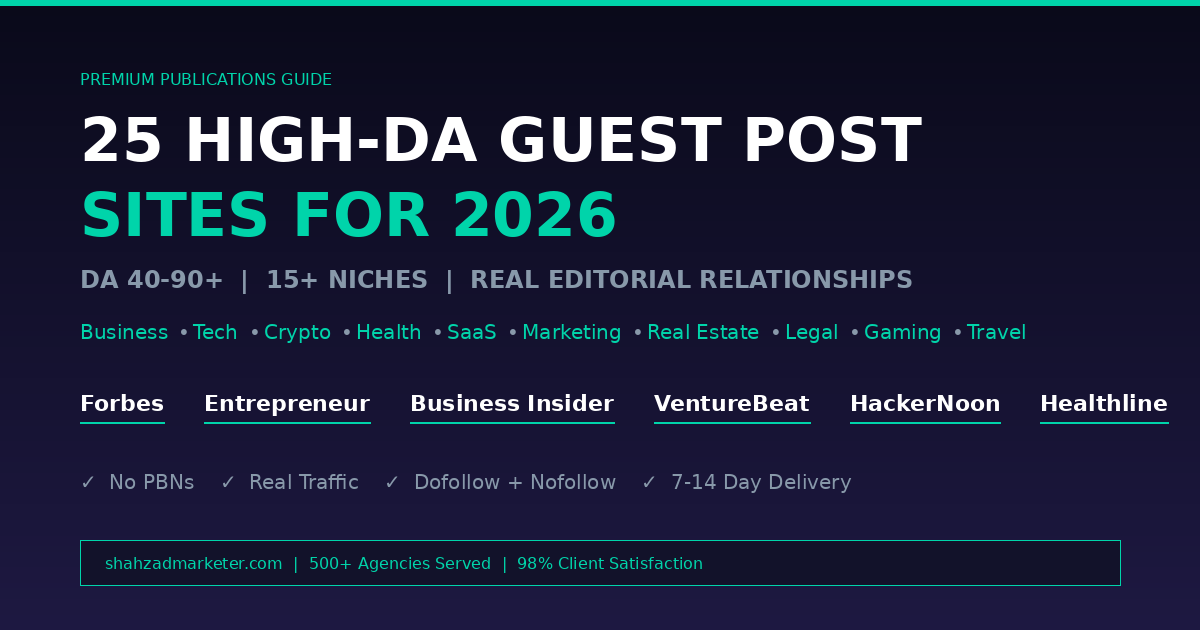
If you’re an agency owner or business leader who’d rather focus on your clients than spend hours hunting down editors and writing pitches, that’s exactly what we handle at shahzadmarketer.com. We maintain direct editorial relationships across 200+ publications — from niche industry blogs to major outlets like Forbes, Business Insider, and Entrepreneur. No PBNs. No link farms. Just real placements on real sites with real traffic.
Grab a free consultation. We’ll audit your current backlink profile, identify the best opportunities in your niche, and map out a placement strategy that actually moves rankings. No obligation. Just a real conversation about what’s possible.
About the Author
Shahzad Khan — SEO & Digital PR Expert, Founder of shahzadmarketer.com. Helps agencies and businesses get published on top-tier publications and build authority through white-hat link building.
Get in Touch
Questions about guest posting, press releases, or getting your brand featured on premium publications? Shahzad is available directly through the channels below:
Email: shahzad@shahzadmarketer.com
LinkedIn: https://www.linkedin.com/in/shahzadmarketer/
WhatsApp: +44 7848 475000
Website: https://shahzadmarketer.com
Response time: Usually within a few hours during working hours. Custom packages and publication queries welcome.

Love this blog! The content is always so relevant and insightful, keep up the great work!